Every lending institution generates operational data.
Borrower interactions. Repayment behaviour. Agency updates. Field activities. Legal proceedings. Transaction history. External intelligence.
The industry doesn't have a shortage of information.
It has a shortage of connected visibility.
That distinction matters more than ever.
Recovery performance is rarely influenced by a single event. It is shaped by hundreds of operational decisions made across multiple teams, systems, and touchpoints every day.
When those decisions are made with incomplete context, even well-designed recovery strategies begin to lose momentum.
A missed borrower interaction delays the next conversation.
A repayment commitment isn't reflected across teams.
A legal update remains isolated from operational workflows.
Field observations never reach the people responsible for making the next decision.
Individually, these may appear insignificant.
Collectively, they influence recovery performance, operational efficiency, and portfolio health.
This is why the future of debt management is no longer defined by how many recovery actions an organisation can execute.
It is defined by how clearly the organisation can see what needs attention before the next action is taken.
Visibility has become a strategic capability.
Moving Beyond Fragmented Operations
Most collection environments have evolved over time.
Different systems support different functions.
Communication happens across multiple channels.
Field teams, agencies, legal operations, and internal collection teams often rely on separate sources of information to complete the same recovery journey.
Each function performs its role effectively.
The challenge is that they rarely operate from the same operational picture.
When visibility is fragmented, prioritisation becomes inconsistent.
When prioritisation becomes inconsistent, response times increase.
And when response times increase, recovery opportunities gradually become harder to capture.
Technology alone does not solve this challenge.
Connected operational intelligence does.
A Different Way to Think About Debt Management
Modern debt management is no longer simply about automating collection activities.
It is about connecting every operational signal that influences recovery decisions.
Borrower interactions should not exist independently of repayment behaviour.
Legal workflows should not operate separately from operational recovery processes.
Agency updates should strengthen portfolio intelligence rather than remain isolated activities.
Analytics should guide decisions—not merely report outcomes.
When operational intelligence becomes connected, every team begins working from the same source of truth.
The result is not simply greater efficiency.
It is greater confidence in every recovery decision.
The RAHI Approach
This philosophy sits at the core of the RAHI Debt Management Platform.
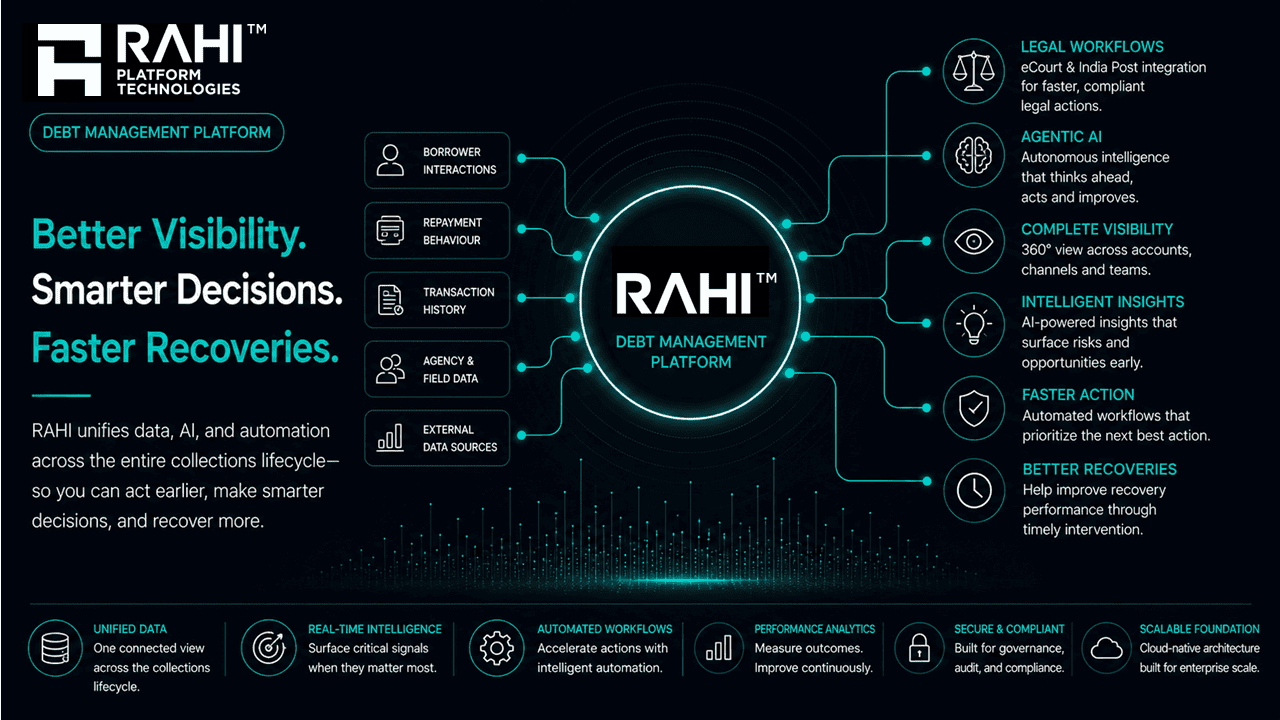
Designed for banks, NBFCs, and HFCs, RAHI brings together operational data, intelligent workflows, AI-driven decision support, legal workflows, field operations, borrower engagement, analytics, governance, and recovery execution within a unified operating environment.
Instead of asking teams to move between disconnected systems, RAHI enables a connected operational view across the collections lifecycle.
Capabilities such as:
Unified operational visibility across borrower interactions, repayment behaviour, transaction history, agency activities, field operations, and external intelligence.
Agentic AI that supports proactive decision-making by recommending next best actions and helping teams respond faster.
Legal workflow orchestration through integrations such as eCourt and India Post, enabling more connected and compliant legal operations.
Intelligent workflow automation that helps prioritise operational effort based on real-time portfolio intelligence.
Enterprise-grade governance, analytics, and compliance controls that support scalable recovery operations.
These capabilities are not intended to replace operational expertise.
They are designed to strengthen it.
Because better operational decisions begin with better operational context.
Visibility Changes More Than Dashboards
When operational visibility improves, recovery operations begin to change in meaningful ways.
Teams identify emerging risks earlier.
Operational priorities become clearer.
Manual coordination is reduced.
Legal and recovery processes become better aligned.
Decision-making becomes faster because information is already connected.
Recovery performance improves—not because teams work harder, but because they work with greater clarity.
That is an important distinction.
The objective is not more activity.
The objective is better-informed activity.
Looking Ahead
As lending portfolios continue to evolve, the institutions that outperform will not necessarily be those with the largest recovery teams or the greatest volume of operational data.
They will be the organisations that build connected operational intelligence across every stage of the recovery lifecycle.
Because the quality of every recovery decision ultimately depends on the quality of the visibility behind it.
Technology is simply the enabler.
Visibility is the advantage.
And that advantage is what drives smarter decisions, stronger operational performance, and faster recoveries.