For many lenders, success is often measured by numbers.
How many loans were disbursed this month?
How fast is the portfolio growing?
How many borrowers are active today?
These are important business metrics. They show growth and scale.
But they don't tell the complete story.
The real challenge begins after a loan is disbursed.
From that moment onward, every loan starts creating a continuous stream of operational events. A repayment is received. A customer raises a request. An EMI is delayed. Interest is recalculated. A document is updated. A notification is triggered. A compliance check is completed. A foreclosure request is initiated.
Individually, these may seem like routine servicing activities.
Together, they determine how efficiently a lending institution operates.
Every servicing event matters.
A single missed update doesn't just affect one loan.
It can delay customer communication.
It can impact collections.
It can create reconciliation issues.
It can increase operational effort.
It can reduce visibility across the portfolio.
When thousands—or even millions—of loans are being serviced simultaneously, these small operational gaps become much larger business challenges.
That's why modern loan servicing is no longer just about maintaining records.
It's about maintaining operational confidence.
The challenge isn't managing more loans.
It's managing every loan consistently.
Many lending institutions still rely on multiple systems to manage different servicing functions.
One system tracks repayments.
Another manages customer requests.
A different application generates reports.
Compliance data may sit elsewhere.
Teams often move between spreadsheets, emails, internal tools and multiple applications just to understand what's happening with a single account.
The result?
Information becomes fragmented.
Teams spend more time finding information than acting on it.
Operational visibility starts depending on manual coordination instead of connected workflows.
As portfolios continue to grow, this approach becomes increasingly difficult to sustain.
Modern servicing requires a connected view.
A Loan Management System is no longer just a platform that records repayments.
It becomes the operational foundation that connects every servicing activity throughout the loan lifecycle.
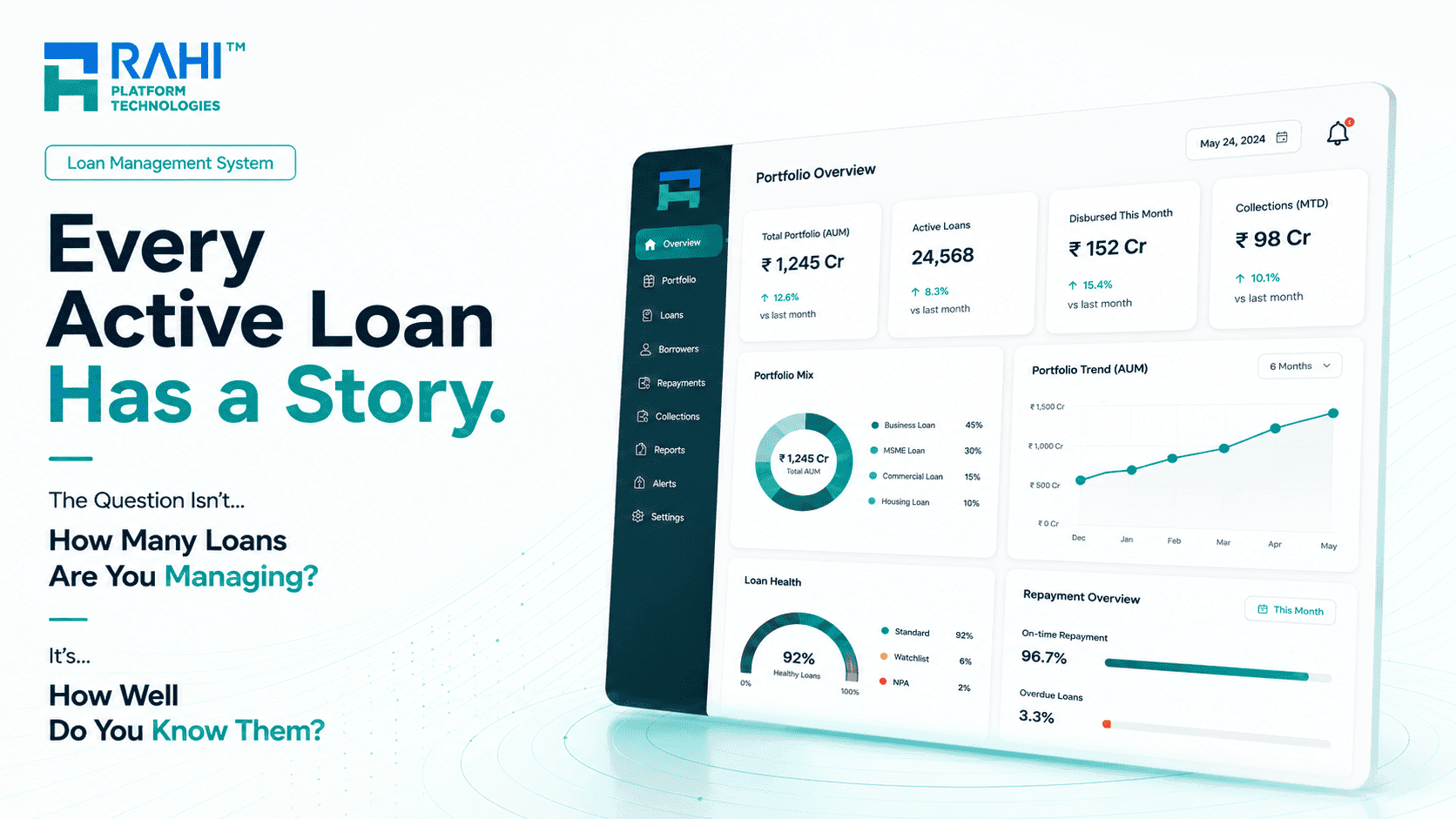
Instead of managing isolated tasks, teams gain a unified view of every active loan.
From repayment schedules and customer servicing to portfolio monitoring, compliance workflows and reporting, every operational event becomes part of one connected ecosystem.
This allows teams to make faster decisions because they have complete context—not just isolated data.
Better visibility leads to better decisions.
When servicing information is connected, operations become more predictable.
Teams can identify delays before they become operational issues.
Customer requests can be resolved faster.
Repayments are tracked more accurately.
Compliance activities become easier to manage.
Portfolio performance becomes easier to understand.
Instead of reacting after problems occur, teams gain the ability to identify patterns early and respond with confidence.
That shift—from reactive servicing to proactive servicing—is where operational efficiency begins.
Scale should not increase complexity.
As lending businesses grow, servicing operations become more demanding.
More borrowers.
More repayment schedules.
More servicing requests.
More compliance requirements.
More operational decisions.
Growth should increase business opportunities—not operational complexity.
A modern Loan Management System helps organizations scale their servicing operations without losing visibility, consistency or control.
By bringing servicing activities onto a unified platform, teams can automate routine processes, standardize workflows and maintain complete oversight across the portfolio.
Every active loan deserves complete visibility.
Every loan has its own journey.
Some borrowers repay on time.
Some need restructuring.
Some require additional servicing.
Some generate customer interactions that influence future decisions.
Understanding these operational moments is what enables lenders to deliver better servicing experiences while maintaining portfolio health.
Because servicing isn't simply about managing accounts.
It's about managing every interaction that shapes the life of a loan.
How RAHI Loan Management System helps
RAHI Loan Management System is designed to help lenders manage the complete servicing lifecycle through a unified, scalable platform.
With RAHI LMS, lending institutions can:
Gain a unified view of every active loan from disbursement to closure.
Automate servicing workflows to reduce manual effort and improve consistency.
Track repayments, customer servicing and portfolio performance in real time.
Strengthen operational governance with built-in compliance controls and audit readiness.
Enable data-driven decision-making through centralized reporting and portfolio insights.
Scale servicing operations confidently as portfolios grow.
Rather than managing servicing through disconnected systems, RAHI LMS brings every operational activity together in one platform—helping teams work more efficiently, respond faster and maintain greater control across the entire loan lifecycle.
Final Thought
A loan doesn't stop evolving after it's disbursed.
Every repayment, every customer interaction and every servicing event adds another chapter to its story.
The question is no longer how many active loans you're managing.
The question is whether you have the visibility, intelligence and operational control to understand every one of them.