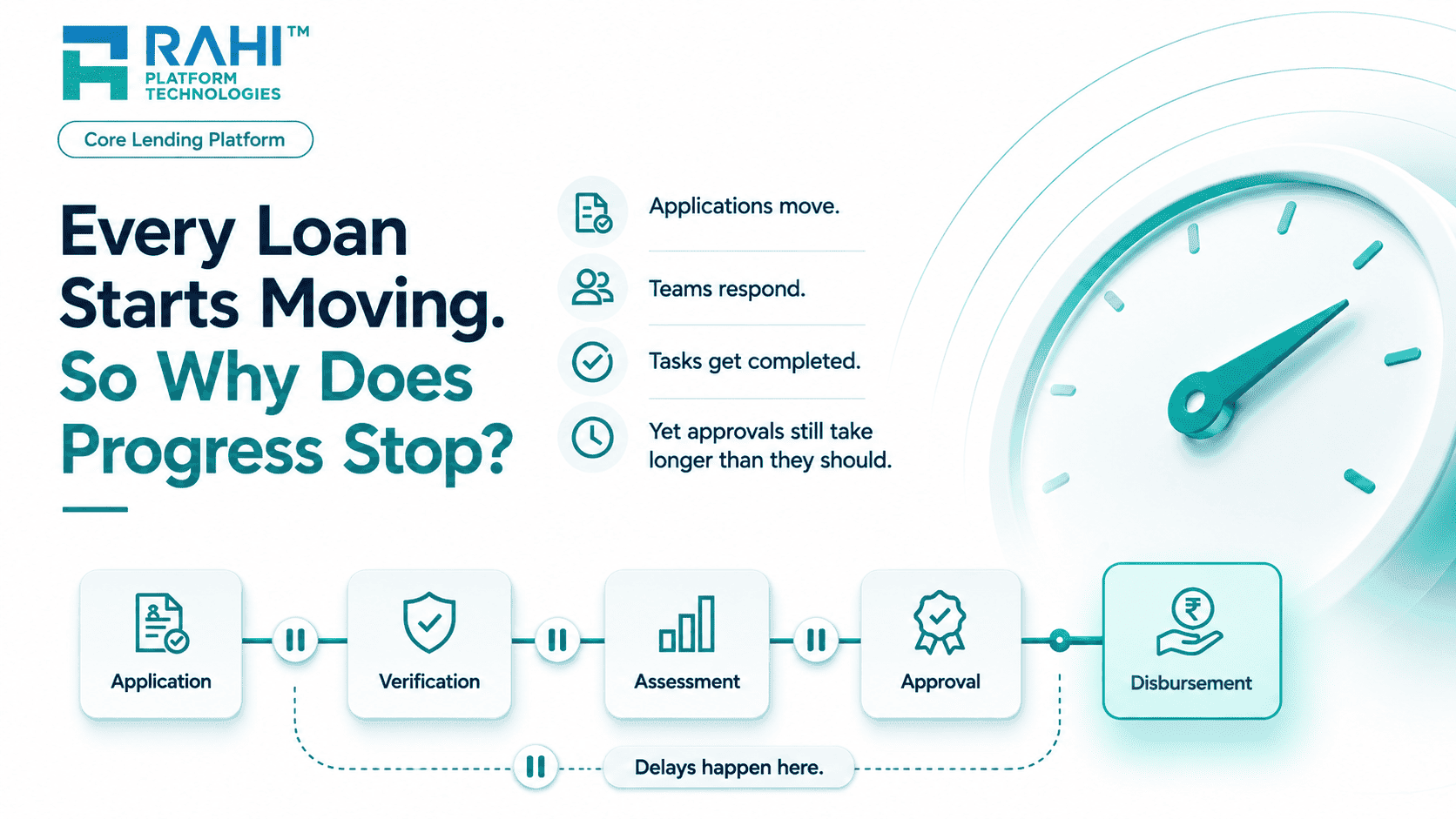
Every lending institution is built around momentum.
An application is submitted. Information is captured. Documents are verified. Credit is assessed. Decisions are made. Funds are disbursed.
Each stage has a clear purpose. Each team has defined responsibilities. Each process is designed to move the customer one step closer to a lending decision.
Yet, despite investments in technology, experienced teams, and structured workflows, many lending operations encounter the same challenge:
Progress slows down long before the loan reaches a decision.
The reason is rarely a lack of effort.
Applications move.
Teams respond.
Tasks are completed.
So why does the lending journey lose momentum?
The answer often lies in the transitions that connect every stage of the lending lifecycle.
Lending Doesn't Slow Down at One Stage. It Slows Down Between Them.
A modern lending operation is not a single process. It is a sequence of interconnected decisions.
An application moves from origination to verification.
Verification passes information to credit assessment.
Credit assessment progresses to approval.
Approval leads to disbursement.
On paper, the journey appears continuous.
In reality, every transition introduces an opportunity for delay.
Information is transferred.
Documents are reviewed again.
Status updates are requested.
Teams wait for missing context.
Approvals pause until the next dependency is resolved.
None of these moments appear significant on their own.
Together, they determine how efficiently a lending operation performs.
The greatest operational bottlenecks are often not found inside individual functions—they emerge in the space between them.
Small Delays Create Large Operational Costs
Every additional handoff introduces friction.
A document already collected may need to be located again.
A credit reviewer may wait for information that already exists elsewhere.
Operations teams spend valuable time coordinating updates instead of progressing applications.
Managers gain visibility only after delays have already occurred.
Meanwhile, borrowers experience uncertainty because progress becomes difficult to predict.
Individually, these interruptions seem manageable.
Across hundreds or thousands of applications, they become operational patterns that influence turnaround time, productivity, customer experience, and ultimately, business growth.
Operational efficiency is not determined by how well one department performs.
It is determined by how seamlessly every department performs together.
The Difference Between Activity and Momentum
Busy operations are not always efficient operations.
Applications can continue moving while momentum gradually disappears.
Teams complete their work.
Systems record updates.
Notifications are sent.
Approvals continue.
Yet every unnecessary pause extends the overall lending journey.
The most effective lending organizations understand that speed is not created by asking people to work faster.
It is created by removing the interruptions that prevent work from flowing naturally from one stage to the next.
Momentum is not measured by how quickly one team completes its task.
It is measured by how continuously the entire lending journey progresses.
Connected Operations Create Better Decisions
Every lending decision depends on context.
When information remains connected throughout the lifecycle, teams spend less time searching for updates and more time making informed decisions.
Instead of recreating information at every stage, they build upon what has already been completed.
Instead of working with fragmented views, they operate from a shared understanding of the customer's journey.
The result is more than operational efficiency.
Decision-making becomes faster because relevant information is immediately available.
Collaboration improves because every function works from the same operational context.
Managers gain real-time visibility into the lending lifecycle instead of discovering issues after they have already affected performance.
Borrowers experience a more predictable and transparent lending journey.
The outcome is not simply faster lending.
It is more confident lending.
Building Momentum Across the Lending Lifecycle
Creating continuous momentum requires more than automating isolated tasks.
It requires an operational foundation that connects the lending lifecycle from beginning to end.
This is the approach behind RAHI Core Lending Platform.
Designed to support the complete lending journey—from origination and credit assessment to servicing, management, and collections—it enables information, workflows, and operational context to move together across every stage.
Instead of multiple disconnected processes operating independently, lending becomes one coordinated operational journey.
Teams work with greater continuity.
Workflows progress with fewer interruptions.
Operational visibility improves.
Decisions become more consistent.
And organizations gain the flexibility to scale lending operations without introducing unnecessary complexity.
The Competitive Advantage Isn't Speed Alone
As lending continues to evolve, customer expectations will continue to rise.
Borrowers expect faster responses.
Institutions expect greater operational efficiency.
Regulatory expectations continue to grow.
The organizations that succeed will not simply process more applications.
They will build lending operations that sustain momentum from the first interaction to the final decision.
Because every application begins with intent.
Every team contributes to progress.
Every decision shapes the customer experience.
The real question is no longer whether lending can move faster.
It is whether momentum can be preserved throughout the entire journey.
And that is where modern lending creates its greatest advantage.