Every loan begins with a purpose.
For a borrower, it may represent the opportunity to expand a business, purchase a home, finance education, or meet an important financial need.
For a lender, it represents much more than a disbursed amount. It becomes a long-term operational responsibility that requires continuous monitoring, timely servicing, regulatory compliance, and consistent customer engagement.
Many organizations view loan servicing as a series of routine activities that happen after disbursement. Repayments are collected, schedules are updated, customer requests are addressed, reports are generated, and the loan continues through its lifecycle.
But in reality, every servicing activity tells a story.
Every repayment confirms customer behaviour.
Every missed instalment highlights a potential servicing requirement.
Every customer interaction provides valuable operational context.
Every document update reflects a change that may influence future decisions.
Every compliance record strengthens governance and audit readiness.
Individually, these may appear to be ordinary operational events.
Collectively, they reveal the health, behaviour, and progress of every active loan within the portfolio.
The question is whether your systems are capturing these signals—or simply recording transactions.
Every servicing event creates operational intelligence.
Loan servicing is often perceived as an administrative function.
In reality, it is one of the most information-rich stages of the lending lifecycle.
A single event rarely affects only one process.
Consider something as simple as an EMI payment.
Receiving a repayment does far more than update an account balance.
It refreshes repayment schedules.
It updates customer servicing records.
It contributes to portfolio performance.
It influences reporting.
It becomes part of the institution's operational history.
Similarly, a customer requesting a repayment schedule, updating contact information, or submitting additional documentation may appear to be isolated interactions. However, each of these events contributes new operational information that helps build a more complete understanding of the loan.
This is why modern lending institutions are moving beyond transaction processing.
They are focusing on operational visibility.
The challenge isn't collecting data.
It's connecting it.
Most lenders generate large volumes of servicing data every day.
Repayment updates.
Customer interactions.
Compliance activities.
Portfolio movements.
Interest postings.
Account adjustments.
Documents.
Communications.
The challenge is rarely the absence of information.
The challenge is that this information often resides across disconnected systems, manual processes, spreadsheets, or separate operational functions.
Operations teams may only see servicing schedules.
Collections teams focus on delinquency.
Customer support teams view service requests.
Compliance teams monitor regulatory activities.
Finance teams concentrate on financial transactions.
Each department has access to valuable information—but often only from its own perspective.
When these operational views remain disconnected, the complete story of the loan becomes difficult to understand.
Teams spend more time reconciling information than making decisions.
Manual effort increases.
Processes become slower.
Customer experience becomes inconsistent.
Operational visibility is reduced.
As lending portfolios grow, these challenges become increasingly difficult to manage.
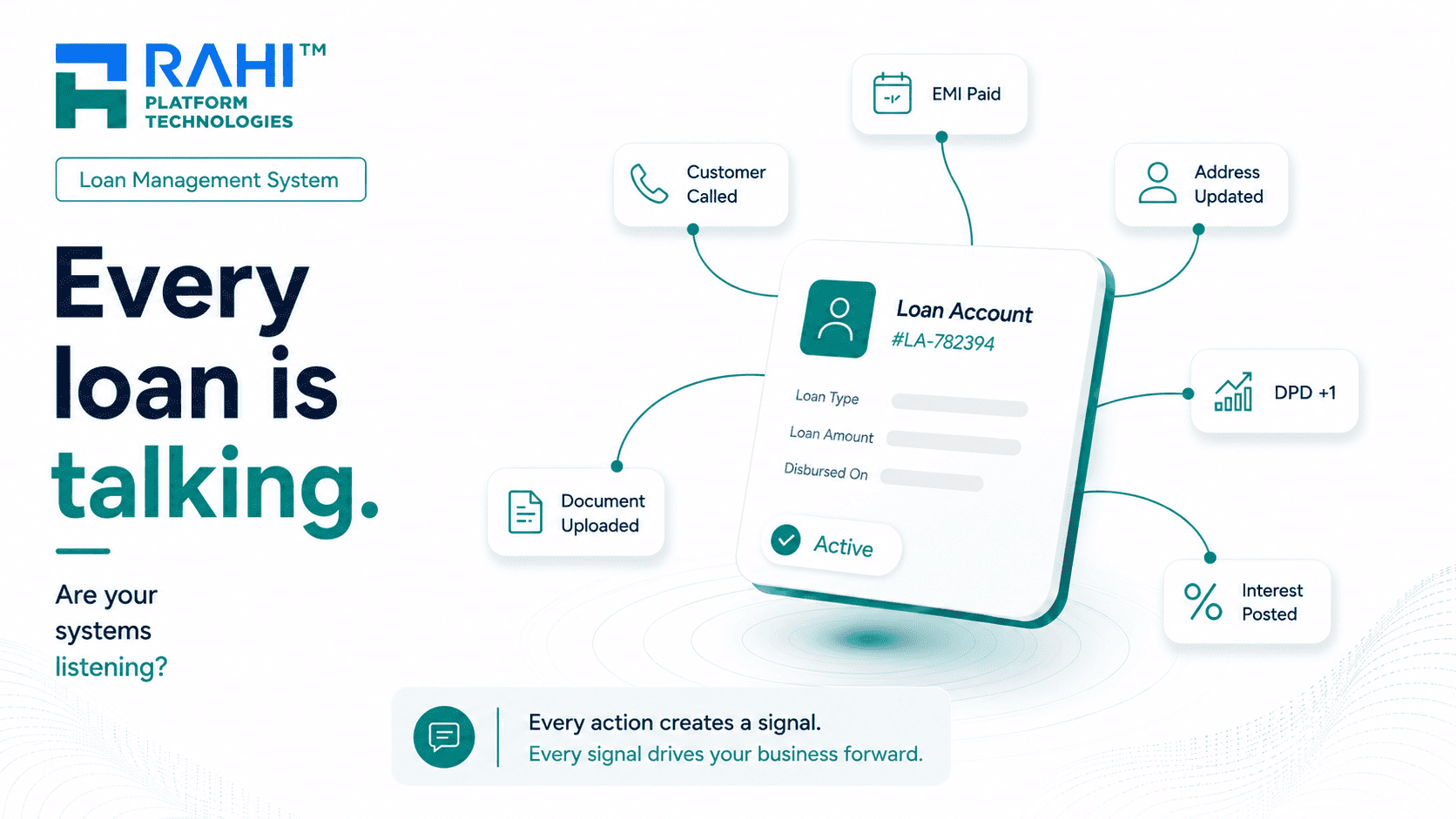
A Loan Management System brings every signal together.
A modern Loan Management System is designed to do more than automate servicing activities.
It creates a connected operational environment where every servicing event contributes to a complete and continuously updated view of each active loan.
Rather than treating repayments, customer servicing, portfolio monitoring, reporting, and compliance as independent functions, an integrated Loan Management System enables these activities to work together.
When servicing information is connected:
Every loan maintains a complete operational history.
Customer interactions become easier to track and manage.
Repayment information remains consistently updated.
Portfolio performance becomes more transparent.
Compliance activities are supported through structured processes and audit trails.
Operational teams work with the same real-time information, improving coordination and reducing manual effort.
This connected approach allows organizations to respond with greater confidence because decisions are based on current operational context rather than fragmented information.
Better visibility leads to better servicing.
Strong loan servicing is not defined by the number of loans an institution manages.
It is defined by how effectively those loans are understood throughout their lifecycle.
A connected operational view allows servicing teams to identify issues earlier, respond to customer requests more efficiently, monitor portfolio health more effectively, and maintain consistent servicing standards across every stage of the loan lifecycle.
This creates tangible operational benefits:
Improved visibility across active loan portfolios.
More consistent servicing processes.
Reduced dependence on manual coordination.
Better collaboration between operational teams.
Faster access to servicing information.
Greater operational efficiency as portfolios grow.
Instead of reacting to events after they occur, organizations gain the ability to manage servicing proactively through connected information and standardized workflows.
Every loan deserves to be understood—not just managed.
Loan servicing extends far beyond repayments and record keeping.
Every interaction, every update, and every operational event adds another chapter to the journey of a loan.
When these signals remain disconnected, valuable context can be lost.
When they are connected, they provide the clarity needed to deliver consistent servicing, improve operational efficiency, and support informed decision-making.
Because every loan is telling a story.
The real question is whether your servicing platform is listening.
RAHI Loan Management System
RAHI Loan Management System helps lenders manage the servicing lifecycle through a unified platform that brings together repayments, customer servicing, portfolio monitoring, compliance, reporting, and operational workflows.
By connecting servicing events into a single operational view, RAHI LMS enables lending institutions to improve visibility, streamline servicing operations, strengthen collaboration across teams, and support informed decision-making throughout the lifecycle of every active loan.