Applications continue to arrive. Teams continue to process them. Decisions continue to be made.
From the outside, lending operations appear to be moving exactly as they should.
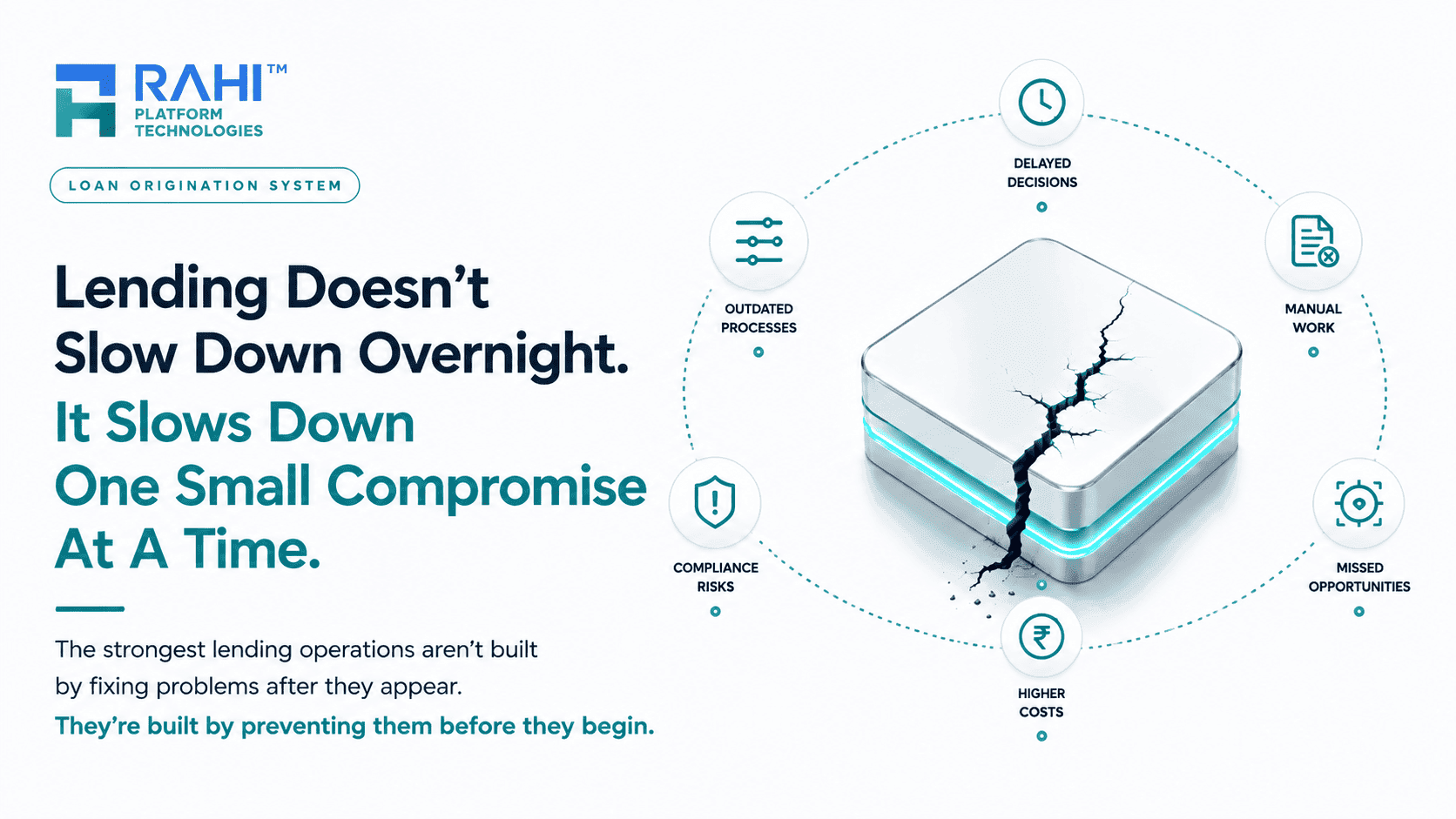
Yet over time, approval cycles become longer, operational costs begin to rise, manual interventions increase, and maintaining consistency across the lending process becomes increasingly difficult. These changes rarely happen because of a single operational failure. Instead, they emerge through a series of small compromises that gradually become embedded in day-to-day operations.
A manual verification step introduced to solve an immediate challenge.
An approval process that becomes increasingly dependent on emails and follow-ups.
Business rules that evolve over time without a consistent governance framework.
Disconnected information spread across multiple operational systems.
Each of these decisions may solve a short-term problem. Together, however, they slowly introduce friction into the lending lifecycle.
This is how lending operations lose momentum—not overnight, but one small compromise at a time.
Operational Friction Rarely Announces Itself
Unlike major technology failures, operational friction develops quietly.
Applications continue to move from one stage to the next.
Teams continue to complete their responsibilities.
Customers continue to receive decisions.
Because lending operations continue functioning, organisations often assume the underlying processes are performing efficiently.
However, operational inefficiencies are rarely measured by whether work gets completed. They are measured by how much additional effort is required to complete that work consistently, accurately and at scale.
A few extra approval steps.
Repeated document verification.
Manual status updates.
Disconnected communication between teams.
Duplicate operational activities.
Individually, these challenges appear manageable.
Collectively, they reduce operational efficiency, increase turnaround times and create unnecessary complexity across the lending journey.
Growth Doesn't Create Operational Challenges. It Magnifies Them.
Every lending institution aims to grow.
More customers.
More products.
More branches.
More lending programs.
More applications.
Growth is a positive indicator of business success.
Operationally, however, growth places greater demands on every process supporting the lending lifecycle.
The workflows that worked effectively for a few hundred applications often struggle to support thousands.
The approval process that once involved a small team becomes increasingly complex across multiple business functions.
Policy management becomes harder to maintain.
Operational visibility becomes more difficult to achieve.
Customer expectations continue to increase while operational complexity grows alongside them.
Growth itself is not the challenge.
Growth simply exposes the limitations of operational processes that were never designed to scale.
Every Stage Matters More Than It Appears
A loan application does not succeed because of a single decision.
It progresses through a connected sequence of operational activities.
Application capture.
Verification.
Assessment.
Decisioning.
Approval.
Disbursement.
Each stage depends on the consistency and accuracy of the one before it.
When information flows seamlessly across these stages, lending operations remain predictable, transparent and efficient.
When even one stage becomes dependent on manual effort or disconnected processes, delays begin to ripple throughout the entire lifecycle.
The result is rarely one isolated delay.
It becomes slower turnaround times.
Reduced operational visibility.
Higher servicing effort.
Inconsistent execution.
Greater compliance pressure.
Increasing operational costs.
These outcomes are often symptoms of the same underlying issue—a fragmented operational foundation.
Strong Lending Operations Are Built Before Applications Arrive
One of the biggest misconceptions in lending is that operational excellence begins when an application enters the system.
In reality, operational excellence begins much earlier.
It begins with how products are configured.
How lending policies are governed.
How business rules are maintained.
How operational workflows are designed.
How information moves across teams.
How consistently every lending decision can be executed.
When these operational foundations are thoughtfully established, every application benefits from that consistency.
When they are not, every new application introduces additional operational effort.
The difference becomes increasingly visible as the organisation grows.
Complexity Should Never Become the Operating Model
As lending portfolios expand, complexity naturally increases.
Supporting multiple lending products.
Managing different customer segments.
Responding to changing regulatory expectations.
Introducing new verification requirements.
Expanding operational teams.
Complexity itself is not a problem.
Allowing complexity to become the operating model is.
Modern lending organisations require an operating environment where change can be introduced without disrupting existing operations.
Business policies should evolve confidently.
Operational workflows should remain consistent.
Information should remain connected.
Decision-making should remain transparent.
Growth should strengthen operational capability—not weaken it.
A Strong Operational Foundation Changes More Than Technology
Technology alone does not improve lending operations.
A stronger operational foundation does.
A modern Loan Origination System helps establish that foundation by enabling lending institutions to manage operational workflows through a unified environment where processes, business rules and information remain connected throughout the origination lifecycle.
Rather than relying on fragmented operational practices, lending teams can work within a structured framework that improves consistency, strengthens governance and provides greater visibility across every stage of the lending journey.
The objective is not simply to digitise existing processes.
It is to create an operational environment capable of supporting sustainable growth while maintaining speed, control and consistency.
Operational Excellence Is a Long-Term Advantage
Every lending institution measures business performance through metrics such as portfolio growth, turnaround time, customer acquisition and operational efficiency.
Behind each of these outcomes lies something less visible but equally important—the quality of the operational foundation supporting them.
The strongest lending businesses are rarely distinguished by how they respond to operational challenges after they occur.
They distinguish themselves by designing operations that prevent unnecessary complexity from accumulating in the first place.
Because operational excellence is rarely created through one significant transformation.
It is built through hundreds of small decisions that consistently improve the way lending operates.
Looking Beyond Today's Applications
The applications being processed today represent only part of the lending story.
The real question is whether the operational environment supporting those applications will continue to perform as the organisation grows.
Will today's workflows remain effective next year?
Will operational visibility improve or decline?
Will manual intervention increase or decrease?
Will business teams spend more time creating value—or managing operational complexity?
The answers to these questions depend less on the number of applications being processed and more on the strength of the operational foundation supporting every one of them.
Conclusion
Successful lending operations are not defined by the absence of complexity.
They are defined by the ability to manage complexity without allowing it to slow progress.
Small operational compromises may seem harmless in isolation, but over time they influence decision-making, operational efficiency, governance and the customer experience.
Recognising these challenges early—and building an operational foundation designed to support consistency, adaptability and scale—helps lending institutions create processes that remain resilient as the business evolves.
Because lending rarely slows down overnight.
It slows down one small compromise at a time.