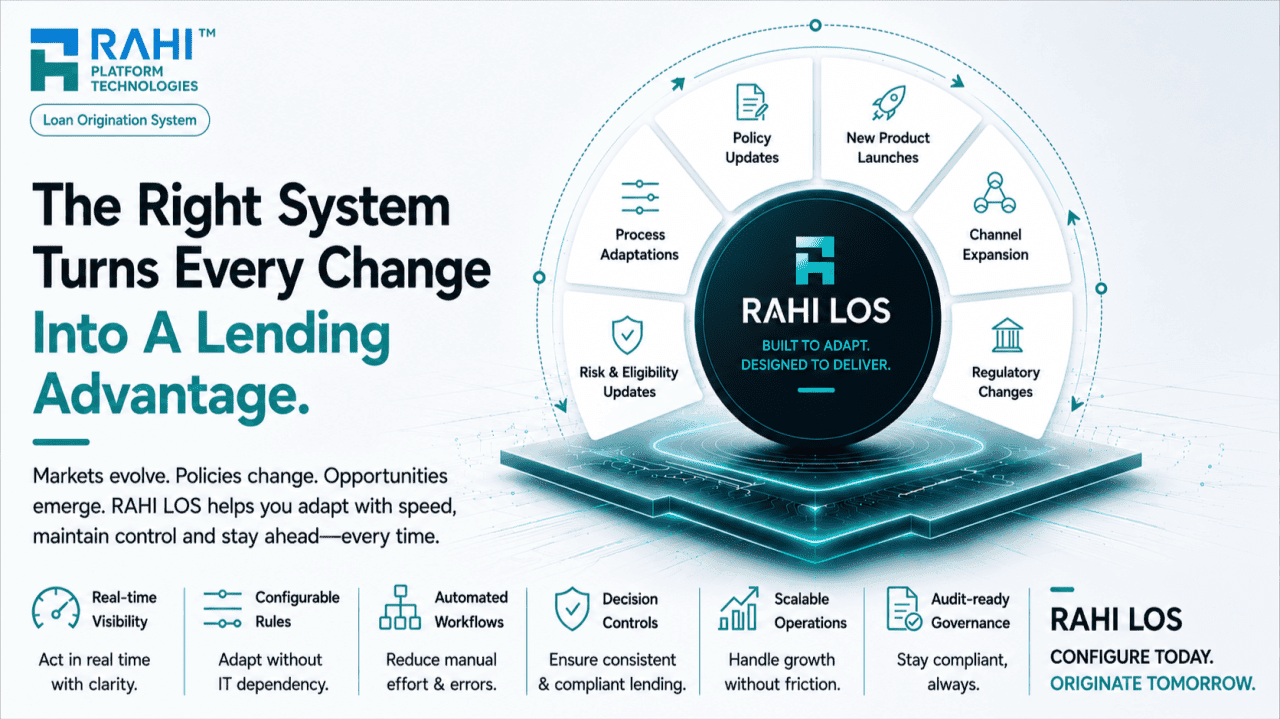
Every lending institution is built to evolve.
Some changes are driven by business ambition. Others are driven by regulation, competition, or changing borrower expectations. New products are introduced. Credit policies are refined. Distribution channels expand. Risk frameworks mature. Approval structures evolve.
None of these changes are unusual.
What often goes unnoticed is the operational effort required to make them work.
Approving a business decision is only the beginning. The real challenge lies in translating that decision into a lending process that is consistent, governed, and ready to execute at scale.
That transformation begins inside the Loan Origination System.
Business Decisions Move Quickly. Operational Execution Doesn't Always Follow.
Launching a new Loan Against Property product may take weeks of planning.
Approving it may take a single meeting.
Making it operational is where the real work begins.
The product must be configured.
Eligibility criteria must reflect the new lending policy.
Document requirements must be updated.
Business rules must align with credit guidelines.
Approval hierarchies must support governance.
Operational workflows must accommodate the new journey.
None of these activities exist independently.
Together, they define how efficiently a lending institution can respond to change.
The business changes once.
The operational impact is felt across the entire origination framework.
Loan Origination Has Become the Operational Foundation of Lending
For many years, Loan Origination Systems were primarily associated with application processing.
That role has changed.
Today, the Loan Origination System is where lending strategy becomes operational execution.
Every lending decision depends on a framework that has already been configured long before an application reaches underwriting.
Products.
Business rules.
Eligibility logic.
Approval matrices.
Workflows.
Document requirements.
Decision governance.
These are no longer supporting functions.
They form the operational foundation that enables lending institutions to execute strategy consistently across every application.
The Cost of Change Is Often Hidden
Growth rarely creates operational complexity overnight.
Complexity builds gradually.
A new product.
An additional approval layer.
A revised policy.
A new sourcing partner.
An updated regulatory requirement.
Each individual change appears manageable.
Over time, however, they reshape the origination process in ways that are not always visible.
The challenge is not introducing change.
The challenge is ensuring every operational dependency evolves with it.
When that doesn't happen, business momentum slows—not because the strategy is wrong, but because execution struggles to keep pace.
Competitive Advantage Is Created by the Ability to Execute Change
Every lending institution develops strategies for growth.
Every institution responds to market opportunities.
Every institution adapts to changing regulations.
What separates high-performing lending organisations is not the number of strategic decisions they make.
It is how effectively those decisions become part of everyday lending operations.
Launching a new lending product does not create competitive advantage.
Operationalising that product efficiently does.
Updating a credit policy does not improve portfolio performance.
Ensuring that policy is executed consistently across every application does.
Expanding into a new market does not guarantee growth.
Building an origination framework that supports expansion without adding operational complexity does.
This is where modern Loan Origination Systems create measurable business value.
Why Adaptability Has Become a Strategic Capability
Change is no longer an occasional event.
It is a constant.
Products continue to evolve.
Policies continue to mature.
Regulatory expectations continue to develop.
Distribution models continue to expand.
The institutions that adapt successfully are not necessarily investing in more technology.
They are investing in technology that has been designed to evolve alongside the business.
A modern Loan Origination System should make change predictable.
It should allow lending institutions to configure products, update business rules, manage workflows, refine approval matrices, strengthen governance, and support policy evolution without repeatedly rebuilding operational processes.
The objective is not simply to automate loan origination.
It is to create an origination framework that evolves with the business.
The RAHI Approach to Loan Origination
At RAHI Platform Technologies, we believe Loan Origination should enable business agility rather than limit it.
RAHI Loan Origination System is designed to help Banks, NBFCs, and Housing Finance Companies operationalise business change through configurable product management, business rule governance, workflow orchestration, eligibility logic, approval matrices, document management, and decision governance.
Whether introducing a new lending product, implementing updated credit policies, expanding distribution channels, or responding to evolving regulatory requirements, RAHI LOS provides a structured origination framework that helps organisations adapt while maintaining consistency, governance, and operational control.
The Future of Lending Will Belong to Institutions That Adapt with Confidence
Every lending institution will continue to evolve.
The pace of change will only increase.
The real question is not whether change will happen.
It is whether your operational foundation can evolve with it.
Because competitive advantage is no longer determined by how quickly decisions are made.
It is determined by how effectively those decisions become governed, scalable, and consistent lending operations.
The strongest lending institutions will not be those introducing the greatest number of changes.
They will be the ones capable of executing change with confidence, maintaining governance as they grow, and adapting without creating unnecessary operational complexity.
That is where modern loan origination creates lasting value.
And that is how the right system turns every change into a lending advantage.