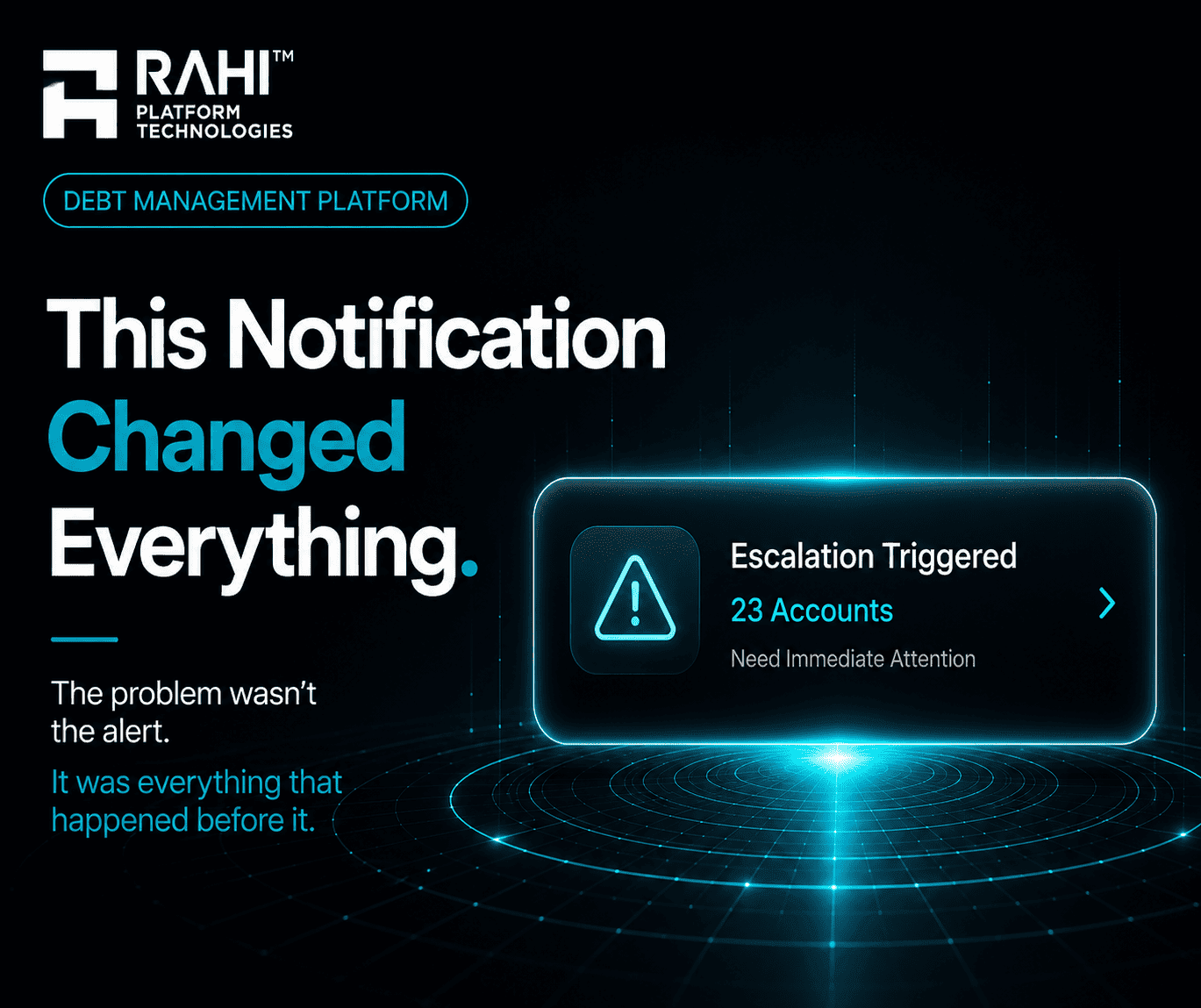
Every collection team has experienced this moment.
A notification appears.
Escalation Triggered.
23 Accounts Need Immediate Attention.
The response is immediate. Teams begin reviewing cases, assigning actions, contacting borrowers, and coordinating the next steps.
The notification demands attention because it represents a problem that requires action.
But there is an important question that often goes unanswered.
What happened before the notification appeared?
The notification is rarely the beginning of the story.
More often, it is the moment the story becomes visible.
Behind every escalation is a sequence of operational events that gradually build over time. A repayment may have been missed. A follow-up might have been delayed. A Promise to Pay may not have been revisited. A field visit may still be pending. Documents, approvals, communications, and collection activities may have progressed at different speeds.
Individually, these events rarely appear significant.
Collectively, they shape the outcome.
By the time an escalation reaches a team's dashboard, the operational journey that created it has often been unfolding for days or even weeks.
That is why modern collections are no longer focused only on responding to alerts.
They are increasingly focused on understanding the operational journey that leads to them.
Every Collection Journey Leaves a Trail
Collections are dynamic.
Every borrower interaction, repayment reminder, follow-up activity, field visit, communication, and operational decision adds another point to the overall journey of an account.
The challenge is not the lack of information.
Most organizations already capture large volumes of operational data.
The challenge is transforming that information into meaningful operational visibility.
When activities are distributed across multiple systems, manual processes, or disconnected workflows, understanding the complete picture becomes more difficult. Teams may need to switch between applications, review historical records, coordinate with multiple stakeholders, or manually reconstruct account activity before determining the next course of action.
This increases operational effort and makes timely decision-making more challenging.
The notification may identify what needs attention.
It does not always explain why it happened.
Understanding that difference can significantly improve how collection teams prioritize their work.
Moving Beyond Reactive Collections
For many organizations, collection success has traditionally been measured by how efficiently teams respond after an account enters a higher-risk stage.
While response time remains important, today's lending environment requires a broader perspective.
Collection teams are expected to manage growing portfolios, support regulatory processes, maintain consistent borrower engagement, coordinate with internal and external stakeholders, and improve operational efficiency—all while maintaining visibility across thousands of active accounts.
Meeting these expectations requires more than alerts.
It requires context.
When teams understand the sequence of operational events leading to an escalation, they can make more informed decisions about prioritization, resource allocation, and next actions.
Operational visibility helps shift collections from reacting to outcomes toward understanding the activities that shape those outcomes.
Visibility Creates Better Operational Decisions
Operational visibility is not simply about seeing more data.
It is about connecting operational events into a meaningful journey.
When borrower interactions, collection activities, promises to pay, field operations, communications, and workflow progress can be viewed together, teams spend less time searching for information and more time acting on it.
This enables collection managers to understand where attention may be required, monitor operational progress across portfolios, and coordinate actions more effectively between teams.
Rather than viewing an escalation as an isolated event, they gain the ability to understand the sequence of activities that contributed to it.
That perspective supports more informed operational decision-making throughout the collection lifecycle.
Bringing the Collection Journey Together
This is the philosophy behind RAHI Debt Management Platform.
RAHI is designed to provide a unified operational view of the collection journey by bringing together collection workflows, borrower interactions, operational activities, field processes, follow-ups, and case visibility within a single platform.
Instead of relying solely on isolated alerts or fragmented information, teams gain a connected view of how collection activities progress over time.
This helps them identify operational gaps, track case progress, coordinate collection activities, and make informed decisions with greater confidence throughout the recovery lifecycle.
The objective is not simply to respond faster.
It is to provide the operational visibility needed to understand how an account reached its current state and support more effective collection operations going forward.
The Story Behind Every Notification
Notifications will always remain an important part of collection operations.
They help teams recognize when immediate attention is required.
But the notification is only one moment within a much larger operational journey.
Every escalation has a history.
Every account has a sequence of interactions.
Every operational decision contributes to the final outcome.
Understanding that journey allows collection teams to move beyond simply reacting to events and toward making better-informed operational decisions.
Because every notification tells you what happened.
Understanding why it happened is what transforms operational visibility into meaningful action.
And that story always begins long before the notification appears.