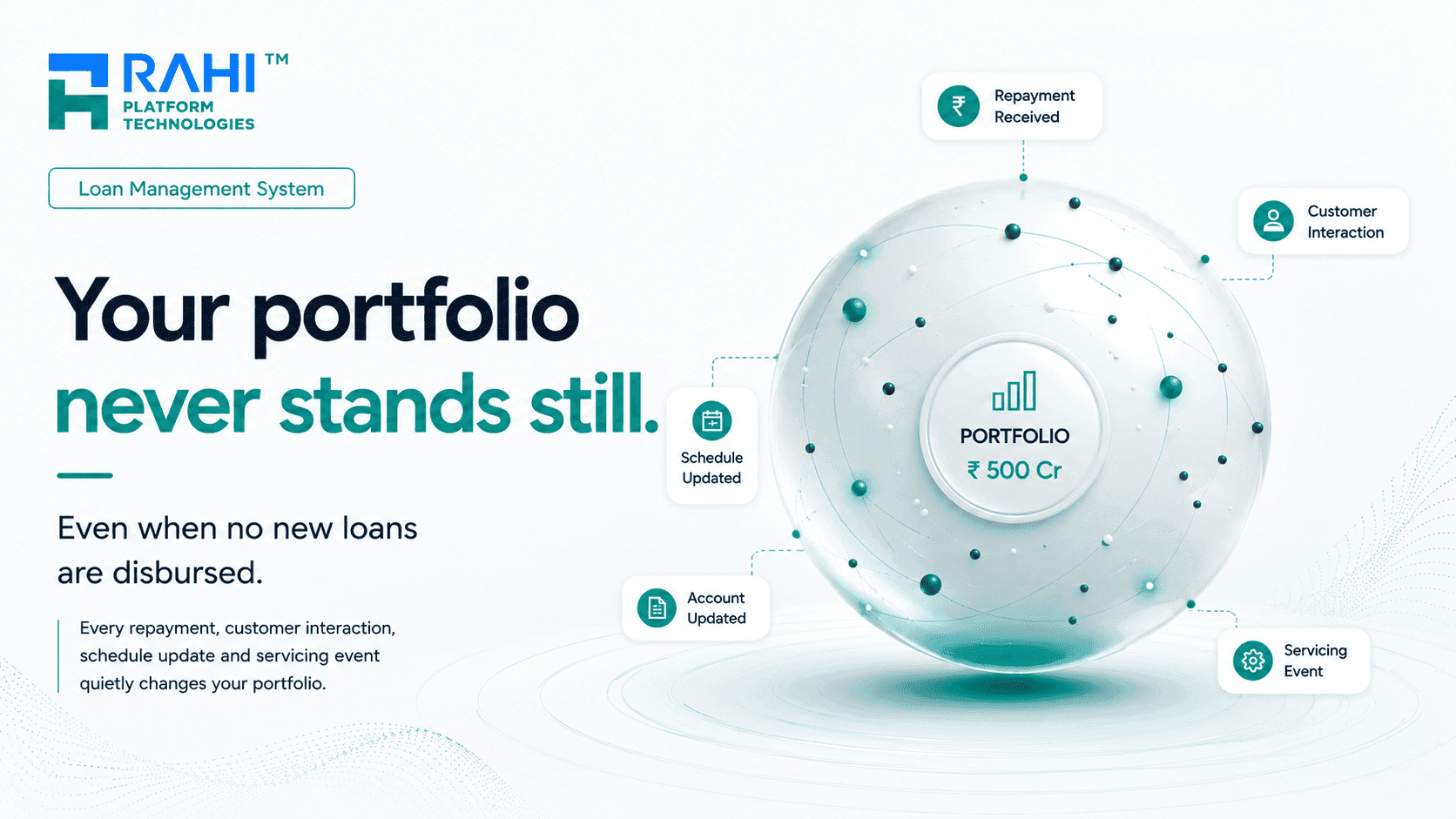
Every servicing event quietly shapes the future of your loan portfolio.
When lenders think about portfolio performance, the first metric that often comes to mind is growth.
How many loans have been disbursed?
How large is the portfolio?
What is the outstanding value?
These are important measures, but they only tell part of the story.
A loan portfolio is far more dynamic than its size or value suggests. Long after a loan has been disbursed, it continues to evolve through hundreds of operational events that occur every day. Repayments are received, customer details are updated, servicing requests are raised, repayment schedules change, documents are uploaded, and account information is refreshed.
Individually, these activities may seem routine.
Collectively, they shape the behaviour, health, and operational readiness of an entire portfolio.
The real question is not whether your portfolio is growing.
It is whether your systems understand how it is changing.
Every loan continues to generate operational signals.
The journey of a loan does not end once the funds are disbursed.
In many ways, that is where the operational lifecycle truly begins.
Every repayment confirms customer behaviour.
Every customer interaction adds valuable servicing context.
Every schedule update reflects a change in repayment obligations.
Every document submission contributes to a more complete customer record.
Every account update ensures that operational information remains current.
Each of these events generates information that helps lenders understand what is happening across their portfolio.
These are not isolated transactions.
They are operational signals that, when viewed together, provide a clearer understanding of portfolio behaviour.
A portfolio is constantly evolving—even when no new loans are added.
One of the most common misconceptions in lending is that a portfolio changes only when new loans are originated.
In reality, a portfolio evolves every single day.
A repayment improves cash flow visibility.
A revised repayment schedule changes future servicing activities.
A customer interaction provides additional operational context.
A document update strengthens record accuracy.
An account update improves the quality of information available to servicing teams.
While none of these activities increase the number of loans in a portfolio, each one changes how that portfolio should be understood and managed.
This continuous evolution makes operational visibility just as important as portfolio growth.
The challenge is not generating information—it is understanding it.
Modern lending operations generate significant amounts of servicing data every day.
Repayments.
Customer interactions.
Schedule updates.
Account modifications.
Supporting documents.
Operational activities.
The issue is rarely the lack of information.
The challenge is ensuring that these events are captured, maintained, and made available in a way that supports informed decision-making.
When servicing information is fragmented across different systems or manual processes, valuable operational context can be difficult to identify.
Teams may spend more time locating information than acting on it.
Operational decisions become slower.
Processes require additional manual effort.
Visibility across the servicing lifecycle becomes limited.
As portfolios grow, maintaining a consistent and accurate operational view becomes increasingly important.
A modern Loan Management System helps lenders stay connected to every change.
A Loan Management System is more than a platform for maintaining loan records.
It provides the operational foundation required to manage loans throughout their servicing lifecycle.
By bringing servicing activities into a structured environment, lenders gain greater consistency in how operational events are recorded, monitored, and managed.
Repayments, customer interactions, schedule updates, account information, and servicing activities contribute to a continuously updated operational view of each loan.
This allows servicing teams to work with accurate information, maintain process consistency, and improve visibility across the portfolio without relying on disconnected records or manual coordination.
Rather than simply tracking completed activities, a Loan Management System helps organizations understand how everyday servicing events contribute to the ongoing state of the portfolio.
Better portfolio visibility supports better operational decisions.
Operational decisions are only as reliable as the information available to the people making them.
When portfolio activity is clearly understood, servicing teams can respond more efficiently, maintain better process consistency, and manage day-to-day operations with greater confidence.
A connected operational view also supports:
Improved visibility across active loan portfolios.
More consistent servicing processes.
Better coordination between operational teams.
Greater accuracy in servicing information.
Reduced dependence on manual tracking.
Stronger operational governance throughout the servicing lifecycle.
These outcomes help lenders manage portfolios with greater clarity as servicing activities continue to evolve.
Every portfolio tells a different story.
Two portfolios may appear identical when measured only by their value.
However, the operational activity within those portfolios may be very different.
One may demonstrate consistent repayments, timely servicing activities, and accurate account information.
Another may require greater operational attention because of servicing delays, frequent customer interactions, or changing repayment schedules.
Understanding these operational differences is essential for maintaining an informed view of portfolio performance.
Because portfolio management is not simply about measuring growth.
It is about understanding continuous change.
The portfolio never stops evolving. Neither should the way it is managed.
Every repayment.
Every customer interaction.
Every schedule update.
Every servicing event.
Every account update.
Each contributes to the ongoing story of a loan portfolio.
Recognizing these operational signals helps lenders move beyond static reporting and toward a more complete understanding of portfolio behaviour throughout the servicing lifecycle.
Because a portfolio never stands still.
And the systems supporting it should be ready to understand every change.
About RAHI Loan Management System
RAHI Loan Management System enables lenders to manage the servicing lifecycle through a unified operational platform that supports repayments, customer servicing, account management, portfolio monitoring, reporting, and servicing workflows.
By helping lenders maintain greater visibility into everyday servicing activities, RAHI LMS supports more informed operational decisions throughout the lifecycle of every active loan.