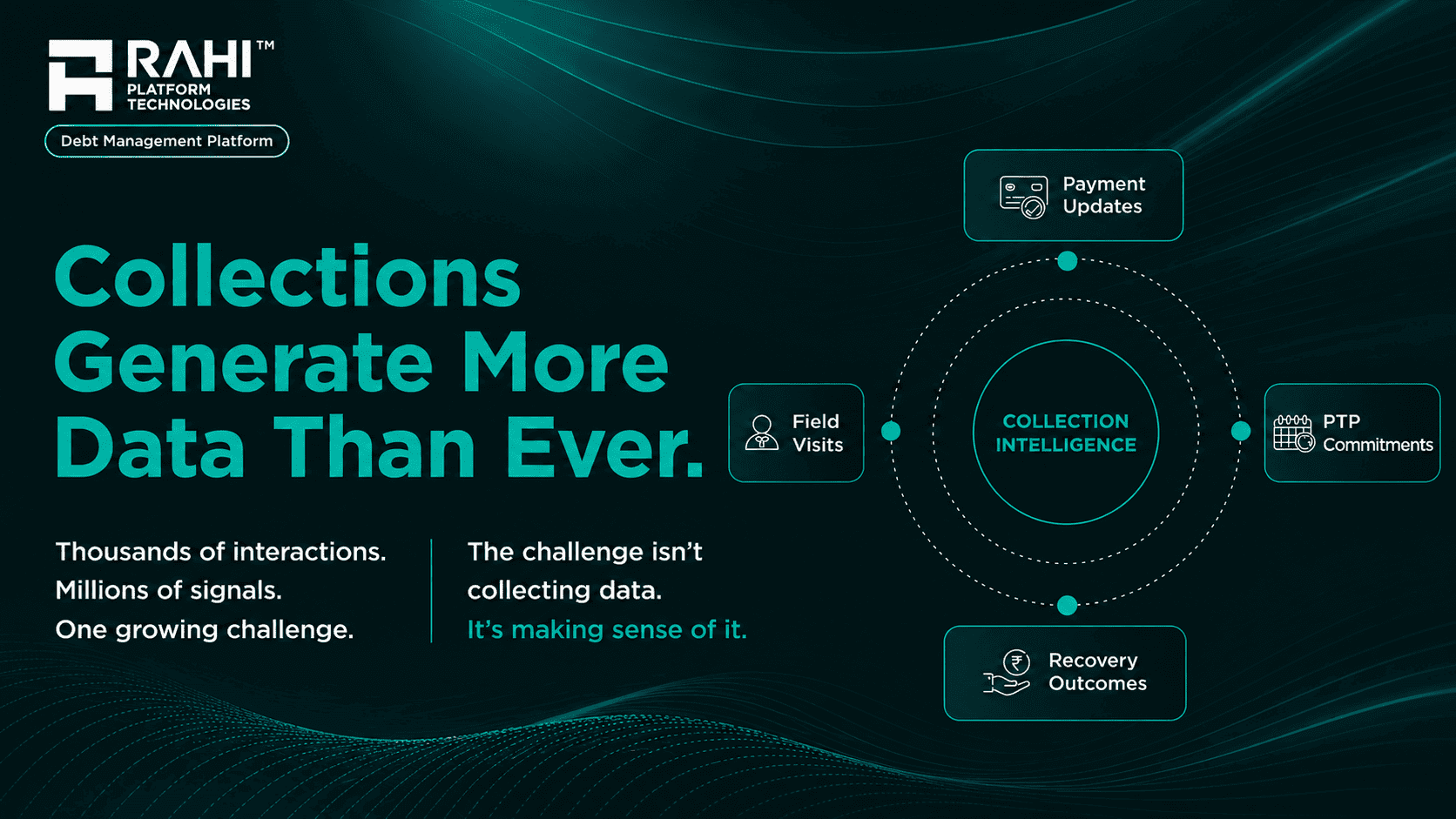
Modern collection operations have become one of the richest sources of operational intelligence within lending.
Every borrower interaction, payment update, field visit, promise-to-pay, digital engagement, and recovery outcome generates valuable data. As lending portfolios continue to expand, so does the volume of information flowing through collection ecosystems.
Yet for many financial institutions, having more data has not necessarily resulted in better decisions.
The real challenge is no longer collecting information.
It is transforming information into intelligence.
The Visibility Gap in Modern Collections
Collection teams today operate across a growing network of channels, systems, and operational processes.
Borrowers interact through multiple touchpoints.
Field teams generate activity from different locations.
Payments arrive through various channels.
Recovery strategies evolve continuously.
While each activity contributes meaningful information, these operational signals often remain disconnected.
When information is fragmented, visibility is compromised.
And when visibility is compromised, decision-making slows.
Collection leaders are left searching for answers to questions that should already be available:
• Which accounts require immediate intervention?
• Which recovery strategies are producing measurable outcomes?
• How are field operations performing across regions?
• Where are emerging portfolio risks beginning to surface?
• Which operational trends require immediate attention?
Without connected visibility, organizations often shift from proactive decision-making to reactive operations.
Why Collection Intelligence Matters
Data, by itself, does not improve recoveries.
Intelligence does.
Collection intelligence is created when every operational signal—borrower interactions, recovery activities, payment behaviour, field operations, and portfolio performance—is connected within a unified decision-making environment.
Instead of relying on isolated reports or manually consolidated information, leaders gain a comprehensive understanding of their collection ecosystem as it evolves.
This enables organizations to identify risks earlier, allocate resources more effectively, improve operational efficiency, and make faster, more informed decisions.
In an increasingly competitive lending environment, visibility is no longer a reporting capability.
It is a strategic advantage.
Building Connected Collection Operations
As portfolios grow, operational complexity grows alongside them.
Managing collections through disconnected workflows, fragmented information, and manual reporting becomes increasingly difficult to sustain.
Modern collection organizations require a connected operating model where people, processes, and data work together as a single ecosystem.
Such an approach enables institutions to:
• Establish a unified view of collection performance.
• Monitor portfolio health in real time.
• Track field activities with greater transparency.
• Strengthen governance and operational oversight.
• Improve recovery effectiveness through intelligence-driven decisions.
The result is not simply greater operational efficiency—it is greater operational confidence.
Enabling Intelligent Collections with RAHI Debt Management System
RAHI Debt Management System has been designed to help Banks, NBFCs, and HFCs navigate the increasing complexity of modern collections.
The platform unifies borrower information, collection workflows, field operations, payment tracking, portfolio analytics, and recovery performance within a single operational environment.
By transforming fragmented operational signals into connected intelligence, RAHI enables collection leaders to move beyond manual coordination and disconnected reporting.
The outcome is a more visible, more agile, and more intelligent collection operation—one capable of responding faster, improving recoveries, and maintaining stronger operational control as portfolios continue to scale.
The Future Belongs to Connected Intelligence
Collection operations will continue to generate increasing volumes of data.
The organizations that succeed will not necessarily be those with the most information.
They will be those that can connect information, uncover meaningful insights, and act with confidence.
Because the future of collections is no longer defined by data alone.
It is defined by visibility.
It is driven by intelligence.
And it is sustained through connected execution.
RAHI Debt Management System
Collection Intelligence. Unified.