For years, financial institutions have been trapped in an impossible technology decision.
On one side: Expensive, rigid legacy lending platforms that are difficult to customize, slow to evolve, and costly to maintain.
On the other: Endless custom development projects that consume months of effort, stretch budgets, create operational dependency, and still struggle to deliver long-term scalability.
For most Banks, NBFCs, and Housing Finance Companies, this has become the hidden operational tax of lending transformation.
And the impact is visible everywhere.
Rising cost per file
Longer turnaround times (TAT)
Fragmented customer journeys
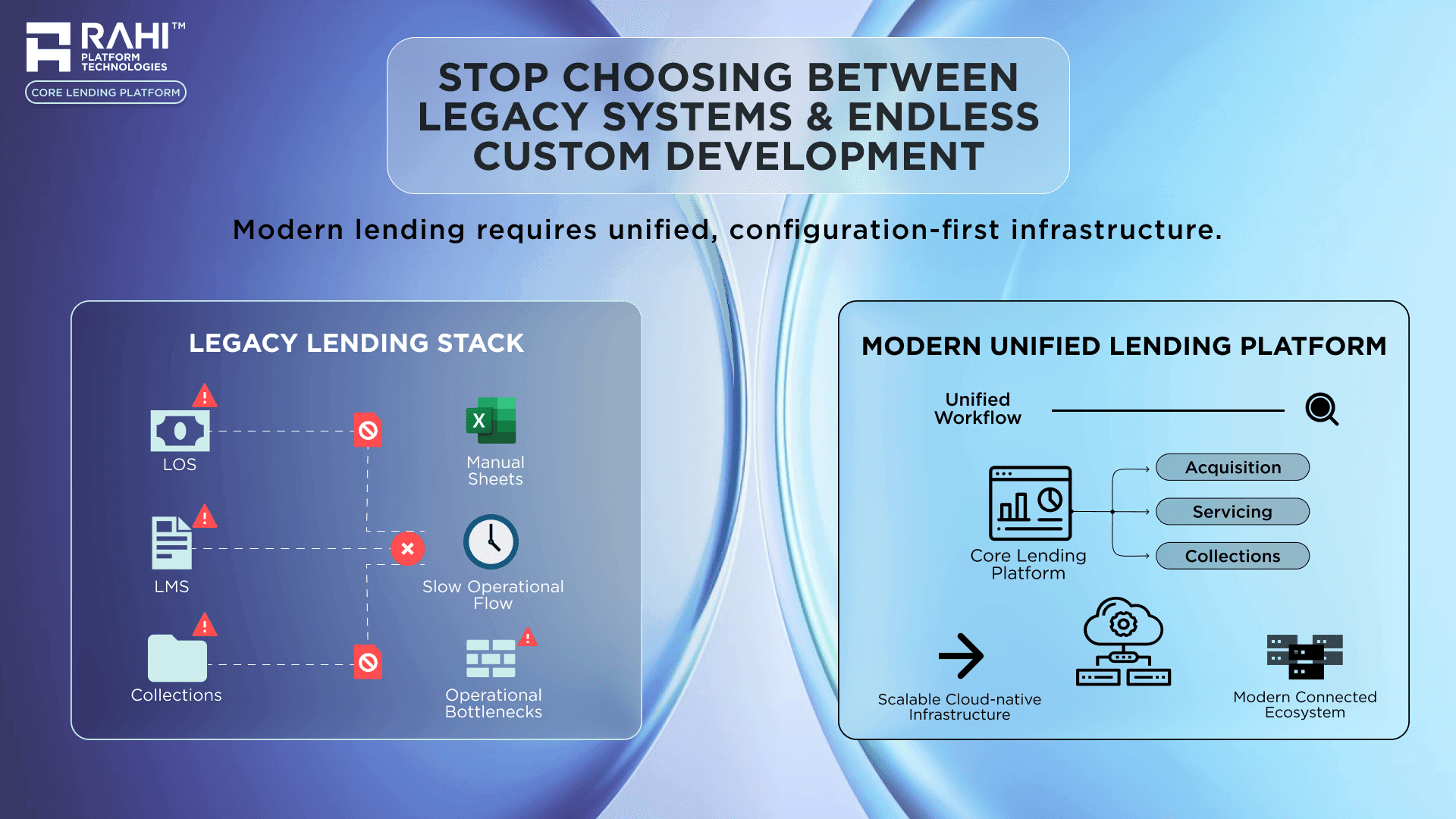
Disconnected LOS, LMS, and Collections systems
Heavy reconciliation dependency
Excel-driven operational workarounds
Compliance and audit challenges
Slow product launches
Limited agility to respond to market changes
The industry does not have a lending problem anymore.
It has an infrastructure problem.
The Legacy Lending Stack Was Never Built For Continuous Credit
Most lenders today operate with multiple disconnected systems across the lending lifecycle:
One vendor for origination
Another for servicing
Separate collections infrastructure
Multiple third-party integrations
Layer upon layer of operational patchwork
The result?
Technology complexity increases every year while operational agility continues to decrease.
Teams spend more time reconciling systems than improving customer experience.
Business teams become dependent on IT for every product change.
Launching a new loan product becomes a multi-month exercise instead of a business decision.
And every new integration adds another layer of cost, risk, and operational friction.
This is the “Build vs. Buy” trap that many lenders continue to face.
There Has To Be A Better Approach
At RAHI Platform Technologies, we believe modern lending infrastructure should not force lenders to choose between:
Flexibility
Scalability
Speed
Cost efficiency
Our approach is simple:
Build a unified, configuration-First Core Lending Platform designed by lending practitioners, for lending practitioners.
A platform that connects:
Loan Origination (LOS)
Loan Management & Accounting (LMS)
Debt Management & Collections
…within a single operational ecosystem.
Why Unified Lending Infrastructure Matters
Modern lenders require continuous visibility across the credit lifecycle.
A disconnected architecture creates:
fragmented borrower visibility
operational silos
duplicate workflows
reconciliation overhead
delayed decision-making
RAHI’s Unified architecture is designed to eliminate these operational gaps by enabling:
real-time lifecycle visibility
seamless workflow orchestration
centralized operational control
configuration-led agility
integrated servicing and collections operations
Instead of stitching together multiple systems, lenders operate through a single connected lending core.
Configuration-First. Not Hard-Coded.
One of the biggest bottlenecks in lending transformation is the dependency on technical customization.
Traditional systems often require:
long development cycles
vendor dependency
costly enhancements
custom code maintenance
This directly impacts business agility.
RAHI’s configuration-first approach changes that.
Business users can:
configure workflows
launch new lending products
modify policies
update business rules
orchestrate operational processes
…without depending on extensive hard-coded development.
This dramatically improves:
time-to-market
operational responsiveness
product innovation speed
scalability
For lenders operating in rapidly evolving regulatory and competitive environments, this agility becomes a major strategic advantage.
Built For Scale, Efficiency, and Lower TCO
Modern lending infrastructure should reduce operational cost — not increase it.
RAHI’s cloud-native architecture is designed to help lenders:
reduce infrastructure overhead
eliminate redundant integrations
simplify operational management
reduce maintenance dependency
improve scalability and resiliency
The result is a significantly optimized Total Cost of Ownership (TCO) while improving operational efficiency across the lifecycle.
More importantly, it creates a future-ready technology foundation capable of supporting the next decade of digital lending innovation.
The Future Of Lending Will Be Unified
The next generation of lending leaders will not compete only on products or pricing.
They will compete on:
operational agility
decision velocity
lifecycle visibility
customer experience
infrastructure efficiency
The institutions that modernize their lending architecture today will be better positioned to scale tomorrow.
The era of fragmented lending systems is coming to an end.
Unified, intelligent, configuration-led lending infrastructure is the future.
And the transition has already begun.