For many years, debt collection has been viewed primarily as a recovery function. But in today's lending landscape, it has evolved into something much larger—an operational discipline that directly impacts profitability, customer experience, compliance, and business sustainability.
As NBFCs and HFCs continue to expand their portfolios, the complexity of managing collections has increased significantly. Borrower expectations have changed, regulatory oversight has become stronger, and organizations are expected to make faster, data-driven decisions.
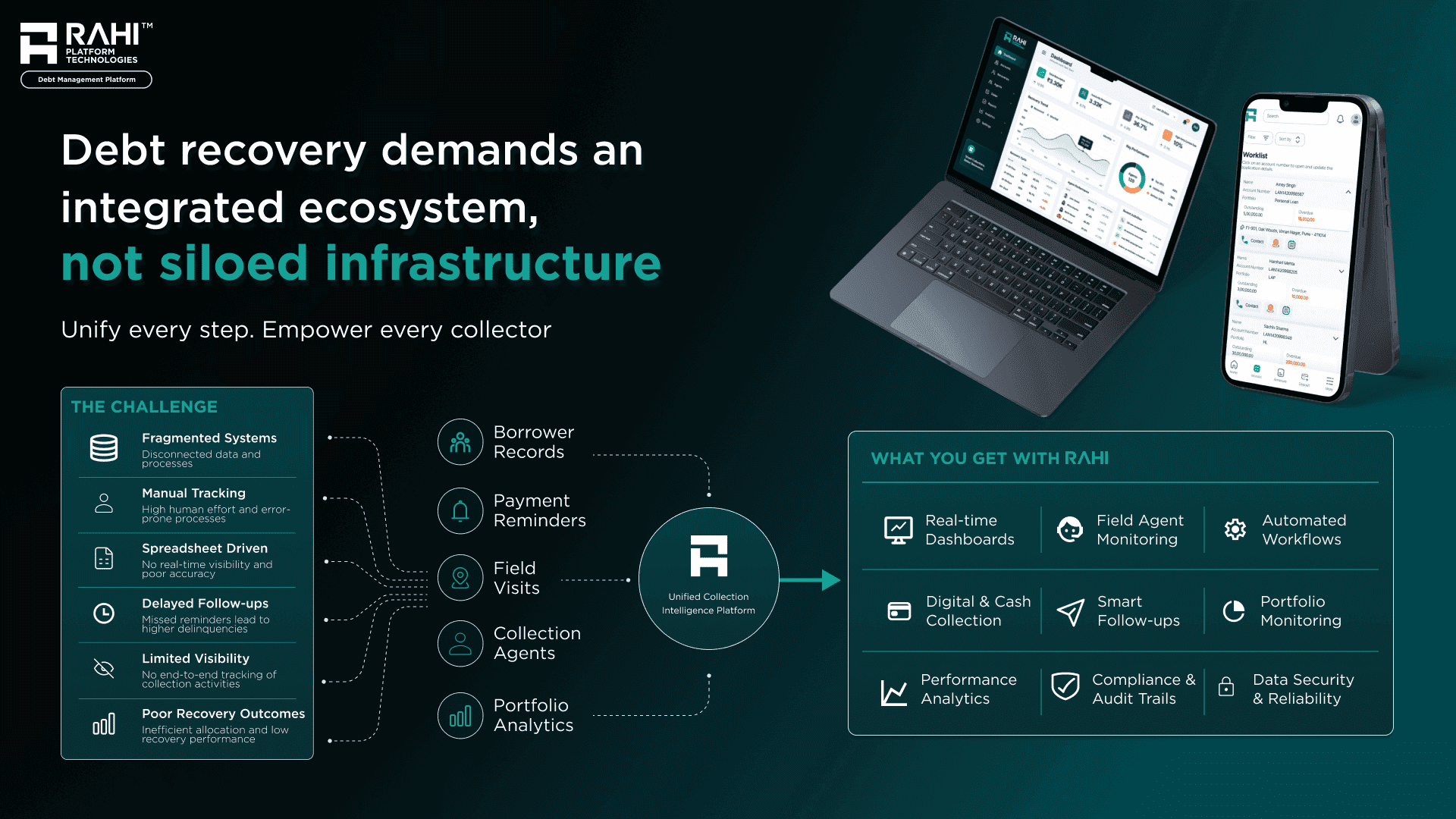
Yet many institutions continue to operate with fragmented collection ecosystems.
The Hidden Challenge-
A typical collection process often involves multiple disconnected systems.
Borrower information may reside in one application.
Collection allocation may happen through spreadsheets.
Field agents may rely on separate mobile tools.
Payment updates may come from different channels.
Management reporting may depend on manually consolidated data.
While each system may perform its individual function well, the lack of integration creates operational friction across the organization.
The result is not simply an IT problem it becomes a business problem.
The Cost of Fragmentation
Disconnected collection operations create several challenges.
1. Limited Visibility
Collection managers often struggle to obtain a real-time view of their portfolio.
Questions such as:
• Which accounts require immediate attention?
• Which field agents are most productive?
• Which regions are underperforming?
• Which borrowers are most likely to default?
can become difficult to answer quickly.
Without visibility, decision-making becomes reactive instead of proactive.
2. Manual Dependency
Many organizations still rely heavily on spreadsheets and manual updates.
This increases:
• Human errors
• Duplicate work
• Delayed reporting
• Operational inefficiencies
As collection volumes grow, manual processes become increasingly difficult to scale.
3. Inefficient Field Operations
Field collection teams play a critical role in the recovery process.
However, without centralized monitoring, organizations may struggle with:
• Agent allocation
• Route planning
• Visit tracking
• Performance measurement
• Digital payment confirmation
This can directly affect recovery outcomes.
4. Data Silos
Different departments often operate with different versions of the same information.
When borrower history, payment records, and collection activities are not synchronized, teams lose the ability to collaborate effectively.
5. Compliance and Audit Challenges
Financial institutions operate in a highly regulated environment.
Maintaining complete activity trails, communication records, and operational transparency is no longer optional.
Disconnected systems make governance significantly more complex.
The Industry Shift
Leading lenders are no longer looking for isolated software products.
They are moving toward integrated collection ecosystems.
The objective is simple:
Create one platform that connects people, processes, and data.
A modern debt management framework should enable:
✓ Centralized borrower management
✓ Intelligent case allocation
✓ Automated follow-ups
✓ Field force digitization
✓ Real-time portfolio monitoring
✓ Digital payment tracking
✓ Performance analytics
✓ Audit and compliance management
Why Intelligence Matters
Technology alone is not enough.
The real advantage comes from turning operational data into actionable intelligence.
Imagine a collection environment where decision-makers can instantly understand:
• Which accounts require priority action.
• Which recovery strategies are producing the best results.
• Which teams need operational support.
• How field activities are impacting portfolio health.
• Where future risks may emerge.
This level of intelligence allows organizations to optimize resources while improving recovery efficiency.
Building a Connected Collection Ecosystem
The future of collections is not about replacing people.
It is about empowering them.
Collection managers need better visibility.
Field agents need better tools.
Leadership teams need better insights.
Borrowers increasingly expect more transparent and seamless interactions.
A connected ecosystem helps align all these stakeholders around a single operational framework.
The Road Ahead
As lending portfolios continue to grow, collection operations will become even more data-intensive.
Organizations that continue to operate with fragmented systems may face increasing operational costs and reduced agility.
Those that invest in unified, intelligent collection frameworks will be better positioned to improve recoveries, strengthen governance, and deliver better customer experiences.
Because ultimately, debt collection should not be a collection of systems.
It should be a connected ecosystem where technology, data, and people work together toward a common objective.
At RAHI, we believe the future of debt management lies in intelligence, visibility, and operational unity.
Collection Intelligence, Unified.