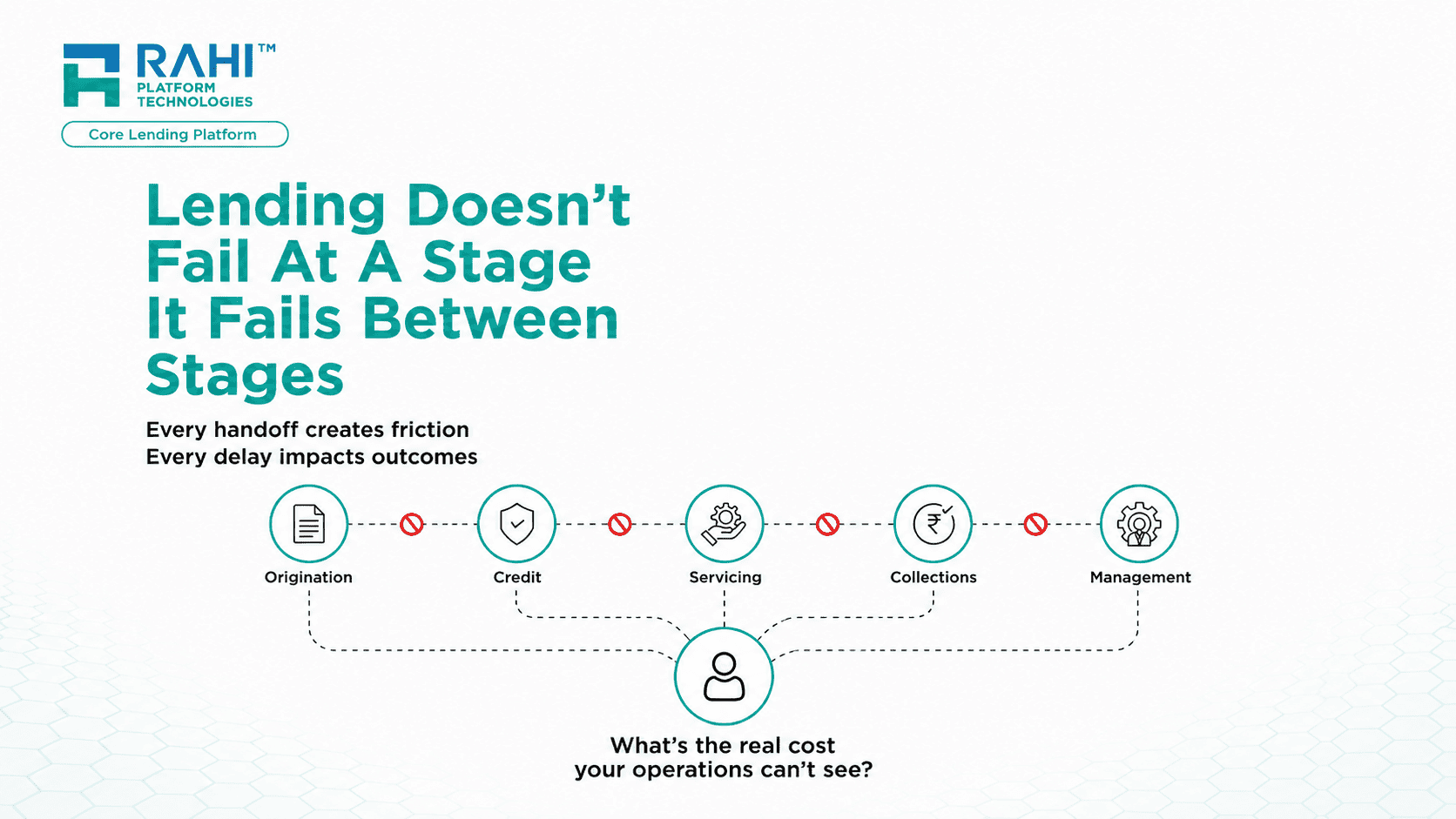
For decades, financial institutions have focused on optimizing individual stages of the lending lifecycle. Loan origination systems have become more sophisticated. Credit policies have become more intelligent. Servicing operations have become increasingly automated, and collections teams have adopted advanced recovery strategies.
On paper, every stage has evolved.
Yet many lending operations continue to experience longer turnaround times, fragmented borrower experiences, operational inefficiencies, and growing execution costs.
Why?
Because lending rarely breaks within a stage.
It breaks between stages.
The transition from origination to credit. The handoff from credit to servicing. The movement from servicing to collections. The transfer of operational intelligence into portfolio management.
These are the moments where operational friction quietly accumulates. Information is revalidated, teams work across disconnected systems, workflows become dependent on manual intervention, and visibility begins to diminish.
While each stage may perform efficiently on its own, the journey between them often remains fragmented.
---
Every Handoff Creates Friction
A lending journey is not simply a sequence of independent operational activities. It is a continuous flow of customer information, business decisions, compliance requirements, servicing actions, and operational intelligence.
Every time responsibility moves from one function to another, the risk of operational disruption increases.
A customer who has already completed onboarding may still be asked to provide the same information during credit assessment. An approved loan may wait for manual processing before disbursement. Servicing teams may operate without complete visibility into previous customer interactions, while collections teams often begin their engagement without a unified operational context.
None of these situations may appear critical in isolation.
However, when they occur thousands of times across a lending portfolio, they create hidden operational costs that affect every part of the business.
Turnaround times increase. Customer expectations are missed. Operational resources become stretched. Decision-making slows. Portfolio visibility becomes fragmented.
The greatest operational cost in lending is often the one that cannot be seen directly—the cost of disconnected transitions.
---
The Problem Is Not the Process. It Is the Connection Between Processes.
Most financial institutions have invested in improving individual capabilities.
Origination has its own platform.
Credit operates through dedicated assessment workflows.
Servicing relies on specialized operational systems.
Collections use separate recovery platforms.
Portfolio management often depends on independent reporting environments.
Each solution may perform effectively within its own domain.
The challenge begins when these domains are expected to function together.
Without a connected operational foundation, every stage creates another handoff, every handoff introduces another delay, and every delay impacts customer outcomes.
Technology should not simply improve individual departments.
It should eliminate the operational boundaries between them.
---
From Fragmented Operations to Connected Lending
Modern lending demands a different approach.
Instead of managing isolated systems, financial institutions need an operating model where customer information, operational workflows, and business decisions move seamlessly across the entire credit lifecycle.
A connected lending ecosystem ensures that every stage builds upon the previous one rather than starting over.
Customer information captured during acquisition supports faster credit decisions. Credit outcomes automatically guide servicing activities. Servicing interactions provide valuable operational context for collections strategies. Portfolio managers gain a complete, real-time view of lending performance instead of piecing together information from multiple systems.
The objective is not simply automation.
The objective is continuity.
When every stage operates on a shared operational foundation, lending becomes faster, more transparent, and significantly more efficient.
---
Why a Digital Lending Stack Changes the Conversation
This is where the concept of a Digital Lending Stack becomes increasingly important.
Rather than viewing origination, credit, servicing, collections, and management as separate technology investments, a Digital Lending Stack connects them into one intelligent operational ecosystem.
Instead of passing customer information from one application to another, information flows continuously.
Instead of rebuilding operational context at every stage, every team works from the same source of truth.
Instead of reacting to delays after they occur, institutions gain real-time visibility into operational performance across the complete lending lifecycle.
A Digital Lending Stack transforms individual lending functions into one connected lending operation.
---
Powering Connected Credit Operations with the RAHI Core Lending Platform
The RAHI Core Lending Platform has been designed around this very principle.
It brings together the essential capabilities required to support the complete lending lifecycle through an intelligent Digital Lending Stack.
Rather than treating Origination, Credit, Servicing, Collections, and Management as isolated operational functions, the platform enables them to work as one connected ecosystem.
Every stage shares operational intelligence. Every workflow contributes to a continuous customer journey. Every decision is supported by greater visibility, automation, and collaboration.
The result is a lending environment where transitions become seamless rather than disruptive.
Instead of operational silos, institutions gain operational continuity.
Instead of disconnected customer experiences, they deliver connected lending journeys.
Instead of solving individual problems, they create an operational framework capable of supporting long-term digital transformation.
---
The Future of Lending Will Be Defined Between the Stages
The next generation of lending excellence will not be determined by how sophisticated an individual loan origination system becomes or how advanced a collections platform is in isolation.
It will be determined by how effectively every stage of the lending lifecycle works together.
Financial institutions that eliminate friction between operational stages will process loans faster, respond to customers more effectively, improve portfolio visibility, strengthen operational efficiency, and create experiences that borrowers increasingly expect.
Those that continue to rely on disconnected operational environments will find that the greatest challenge is not within their individual systems—it is in the gaps that exist between them.
Because lending doesn't fail at a stage.
It fails between stages.
And the institutions that remove those invisible barriers will shape the future of digital lending.