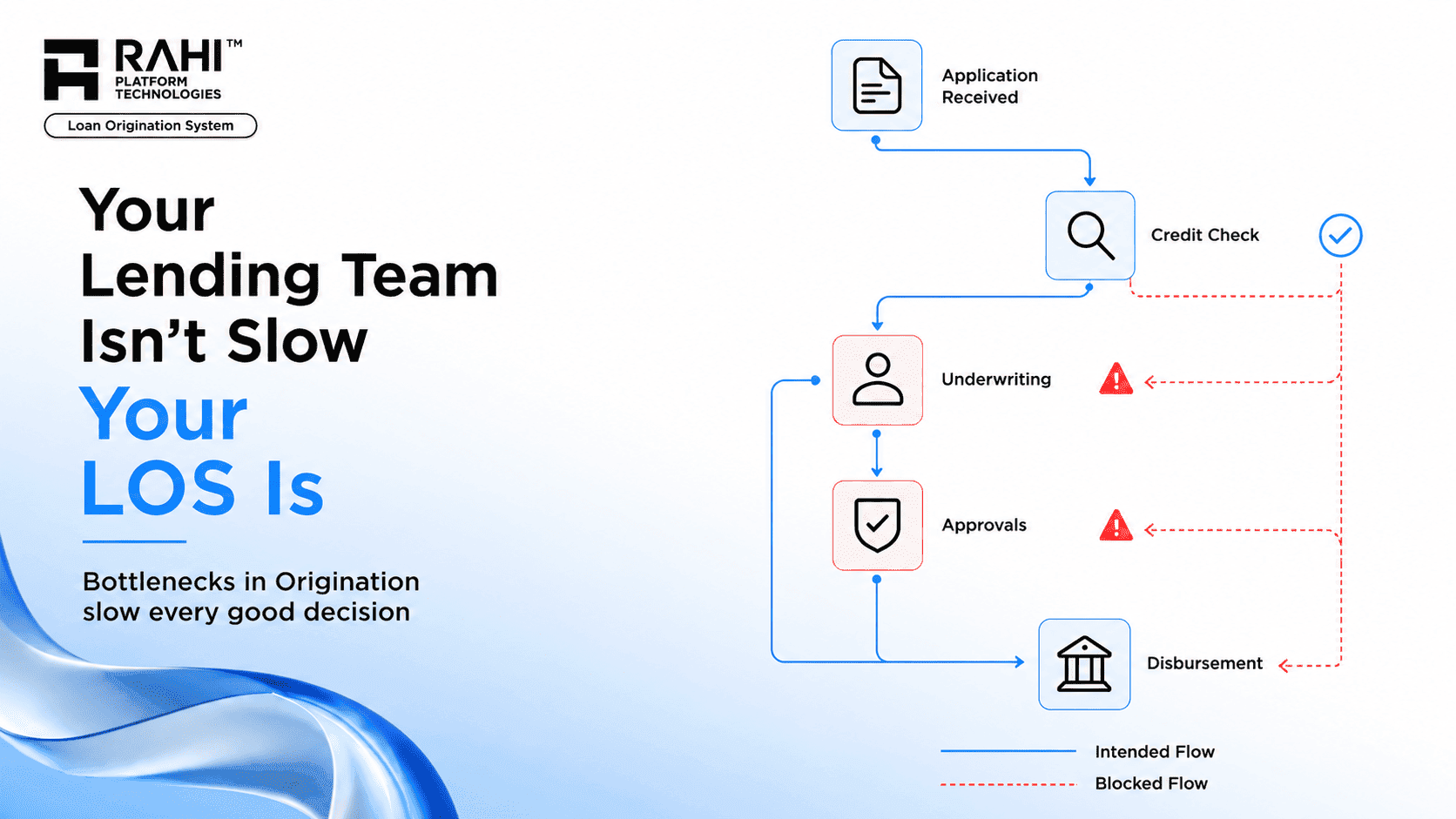
Every lending institution strives to achieve the same objective: evaluate applications efficiently, make consistent credit decisions, and deliver a seamless borrowing experience without compromising governance or compliance.
Yet, despite investing in experienced lending teams, well-defined credit policies, and established operational processes, many financial institutions continue to struggle with delays across the loan origination journey.
When turnaround times increase, the immediate assumption is often that operations need to become more efficient or that credit teams need to process applications faster.
In reality, that assumption is frequently incorrect.
More often than not, the real bottleneck lies within the Loan Origination System itself.
An inflexible LOS can quietly slow every stage of the lending journey—not because teams lack expertise, but because the technology supporting them cannot keep pace with the evolving needs of the business.
The Hidden Bottlenecks in Loan Origination
Loan origination is far more than a sequence of operational tasks. It is a chain of interconnected decisions where each stage depends on the successful completion of the previous one.
An application enters the system through customer onboarding. It progresses through document verification, credit assessment, underwriting, approval workflows, and finally disbursement.
Each step appears straightforward when viewed independently.
The challenge begins when the movement between these stages becomes inconsistent.
A missing document sends an application back for clarification.
An underwriting observation triggers another review.
A policy exception creates an additional approval path.
A manual intervention delays the next operational step.
Individually, these interruptions appear insignificant.
Collectively, they create friction that slows the entire lending process.
The impact extends far beyond turnaround time.
Operational teams spend more time resolving exceptions than processing applications. Credit teams revisit the same files repeatedly. Business leaders lose visibility into where delays are actually occurring, while customers experience uncertainty during what should be a predictable lending journey.
The issue is rarely the capability of the people involved.
It is the inability of the system to orchestrate every decision efficiently.
Why Modern Lending Demands More Than Process Automation
The lending landscape has changed significantly over the past few years.
Banks, NBFCs, and Housing Finance Companies are no longer competing solely on interest rates or product offerings. They are expected to launch new lending products faster, respond to changing borrower expectations, support multiple acquisition channels, and comply with evolving regulatory requirements—all while maintaining portfolio quality.
These business changes place continuous pressure on origination operations.
A new lending product introduces additional eligibility criteria.
A revised credit policy affects underwriting logic.
A new distribution channel requires different onboarding workflows.
Regulatory updates demand changes to documentation, validations, and approval controls.
Each business decision creates a ripple effect across the entire origination process.
When an LOS relies on rigid workflows or extensive development effort to accommodate these changes, operational agility begins to decline.
Business teams become dependent on technical releases for routine modifications.
Operational complexity increases with every change.
The result is an origination process that gradually becomes harder to manage, even though the underlying business objectives remain the same.
The Cost of an Inflexible Origination Process
The consequences of an outdated or inflexible LOS are not always immediately visible.
Applications continue to move through the system.
Loans continue to be approved.
Disbursements continue to occur.
However, beneath the surface, operational inefficiencies accumulate.
Applications revisit the same stages multiple times.
Approval paths become increasingly complex.
Business rules evolve without consistent governance.
Manual interventions become routine rather than exceptional.
Teams spend valuable time working around system limitations instead of focusing on credit decisions and customer outcomes.
As lending volumes grow, these inefficiencies become more pronounced.
What begins as a small operational delay eventually impacts productivity, operational costs, scalability, and customer experience.
Growth does not create these challenges.
Growth simply exposes them.
Rethinking the Role of a Loan Origination System
A modern Loan Origination System should do far more than digitize applications.
It should provide the operational foundation that allows lending organizations to adapt continuously without disrupting ongoing business.
This means enabling configurable workflows that evolve with changing business requirements.
It means supporting rule-driven decisioning that maintains consistency across lending products.
It means ensuring that customer onboarding, document management, bureau integrations, eligibility computation, underwriting, approval matrices, compliance validations, and disbursement readiness operate as part of one coordinated decision framework.
When these capabilities work together, lending teams are no longer constrained by operational bottlenecks.
Instead, they gain the flexibility to introduce new products, refine credit policies, and respond to market changes while maintaining governance throughout the origination lifecycle.
How RAHI LOS Helps Lending Teams Move Forward
RAHI LOS is designed around the realities of modern lending operations.
Rather than treating origination as a series of disconnected activities, it brings together every critical stage of the lending journey within a configurable and business-driven operating framework.
From customer onboarding and document management to credit assessment, underwriting, approvals, and disbursement readiness, every process is governed through configurable workflows and centralized business rules.
This enables lending institutions to adapt to changing products, policies, and regulatory requirements without creating unnecessary operational disruption.
More importantly, it allows business teams to remain focused on making sound lending decisions instead of navigating system constraints.
The objective is not simply to process applications faster.
It is to create an origination process that remains resilient, consistent, and scalable as the business evolves.
Looking Ahead
The future of lending will not be defined by how quickly financial institutions process applications alone.
It will be defined by how effectively they manage change without compromising operational consistency.
As lending products diversify, regulations evolve, and customer expectations continue to rise, the organizations that succeed will be those whose origination platforms are designed to adapt—not merely automate.
Technology should strengthen the lending process, not become the reason it slows down.
Because when every stage of origination is connected through a system built for change, experienced lending teams can focus on what truly matters: making timely, informed, and consistent credit decisions.
Your lending team isn't slow.
Your Loan Origination System shouldn't slow them down either.