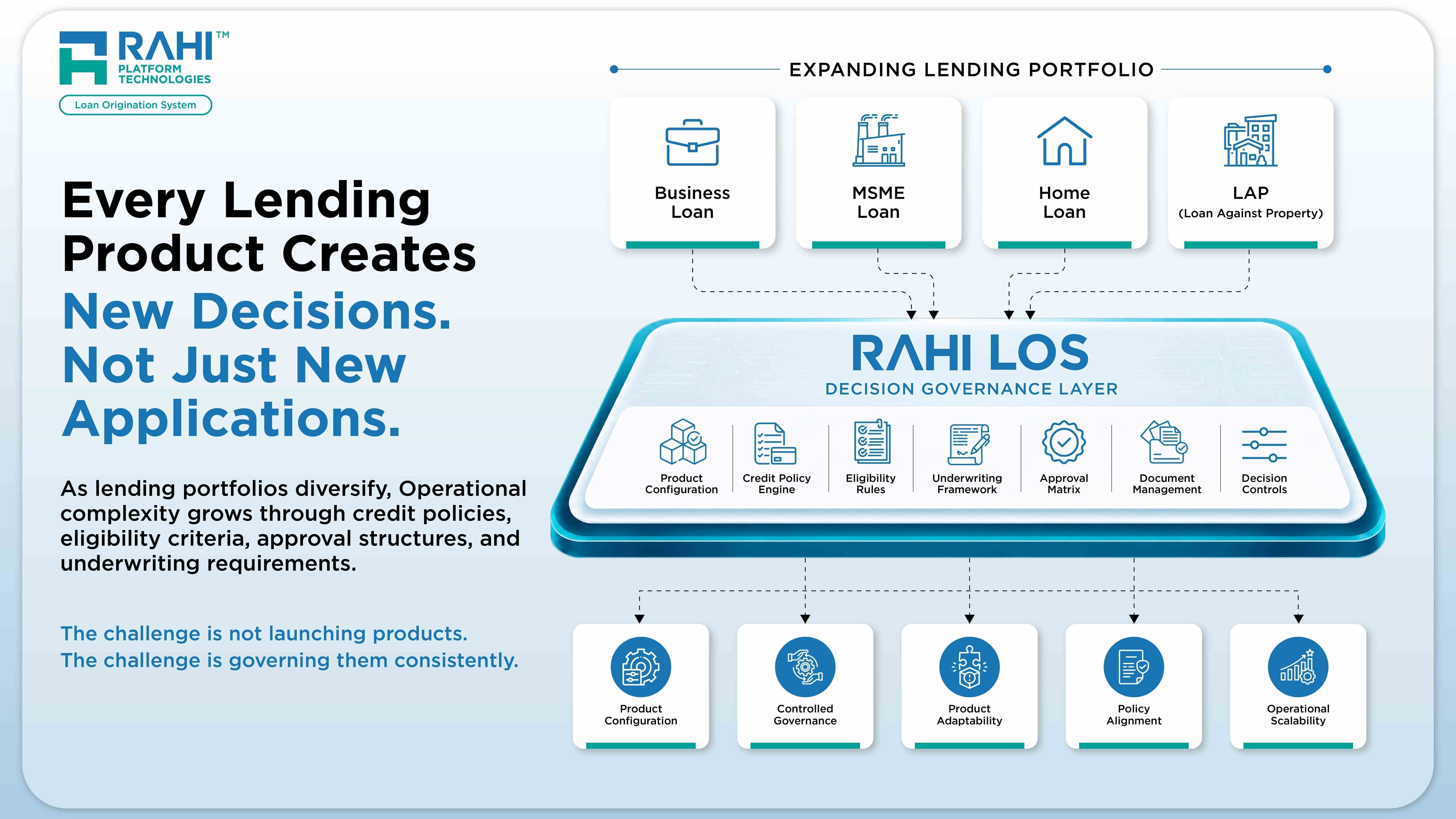
The lending industry is becoming increasingly diversified.
Banks, NBFCs, and Housing Finance Companies are expanding beyond a single lending product to serve broader customer segments and unlock new growth opportunities.
Business Loans.
MSME Lending.
Housing Finance.
Loan Against Property (LAP).
Each product serves a different borrower need.
Each product addresses a different market opportunity.
However, every new lending product introduces something that is often underestimated.
Not applications.
Decisions.
As portfolios expand, institutions are not simply managing more borrowers.
They are managing more policies, more eligibility criteria, more underwriting requirements, and more approval structures.
The challenge is no longer product expansion alone.
The challenge is governing the decisions that come with it.
1. Every Product Introduces A New Decision Framework
A lending product is much more than a new offering in the market.
Behind every product sits a unique set of lending decisions.
For example:
• Business Loans may require different financial assessments.
• MSME Loans may introduce industry-specific underwriting considerations.
• Housing Loans often involve additional verification and documentation requirements.
• LAP products may require valuation checks and collateral assessments.
While the customer sees a new product, the lending organization must manage an entirely new decision framework.
As products accumulate, so do the decision models that support them.
2. Product Expansion Creates Operational Complexity
Growth is often viewed through the lens of portfolio size.
However, operational complexity tends to grow faster than application volumes.
Each new product can introduce:
New credit policies
New eligibility criteria
New underwriting requirements
New approval authorities
New documentation standards
New compliance controls
Individually, these changes may appear manageable.
Collectively, they create a significantly more complex origination environment.
This is why many lending institutions discover that scaling products is not simply a business challenge.
It is an operational governance challenge.
3. More Products Require More Consistency
As portfolios diversify, maintaining consistency becomes increasingly important.
The objective is not simply to launch products.
The objective is to ensure that every product operates within a controlled lending framework.
Lenders must ensure consistency across:
• Credit policy execution
• Eligibility assessment
• Underwriting standards
• Approval structures
• Documentation controls
• Governance processes
Without consistency, product growth can gradually introduce variations in how lending decisions are executed across the organization.
4. Decision Governance Is Becoming A Strategic Priority
The lending landscape continues to evolve.
Regulations change.
Risk conditions shift.
Customer expectations increase.
New products enter the market.
As a result, lending institutions must adapt continuously.
This makes decision governance increasingly important.
Decision governance ensures that product changes, policy updates, and operational requirements remain aligned with the institution's lending strategy.
It enables lenders to introduce new products without losing control over the decisions that support them.
The question is no longer:
"Can we launch another product?"
The question is:
"Can we govern that product effectively at scale?"
5. The Role Of Modern Loan Origination Systems
Historically, Loan Origination Systems were evaluated primarily on their ability to digitize applications and automate processes.
Today, their role is significantly broader.
Modern Loan Origination Systems increasingly act as decision governance layers.
They help institutions manage:
Product Configuration
Credit Policies
Eligibility Rules
Underwriting Frameworks
Approval Matrices
Document Management
Decision Controls
As product portfolios expand, these capabilities become critical for maintaining consistency across the origination lifecycle.
How RAHI LOS Supports Multi-Product Lending
RAHI LOS is designed to help lending institutions manage multiple lending products through a structured decision governance framework.
By enabling configurable product setup, credit policy management, eligibility rules, underwriting controls, approval matrices, document management, and decision governance, RAHI LOS helps institutions support portfolio expansion without creating uncontrolled complexity.
Final Thought
The future of lending will involve more products, more specialization, and more borrower segments.
But every new lending product creates more than a new revenue opportunity.
It creates new decisions.
The institutions that scale successfully will not necessarily be those that launch the most products.
They will be the ones that can govern those products consistently.
Because every lending product creates more than new applications.
It creates new decisions.