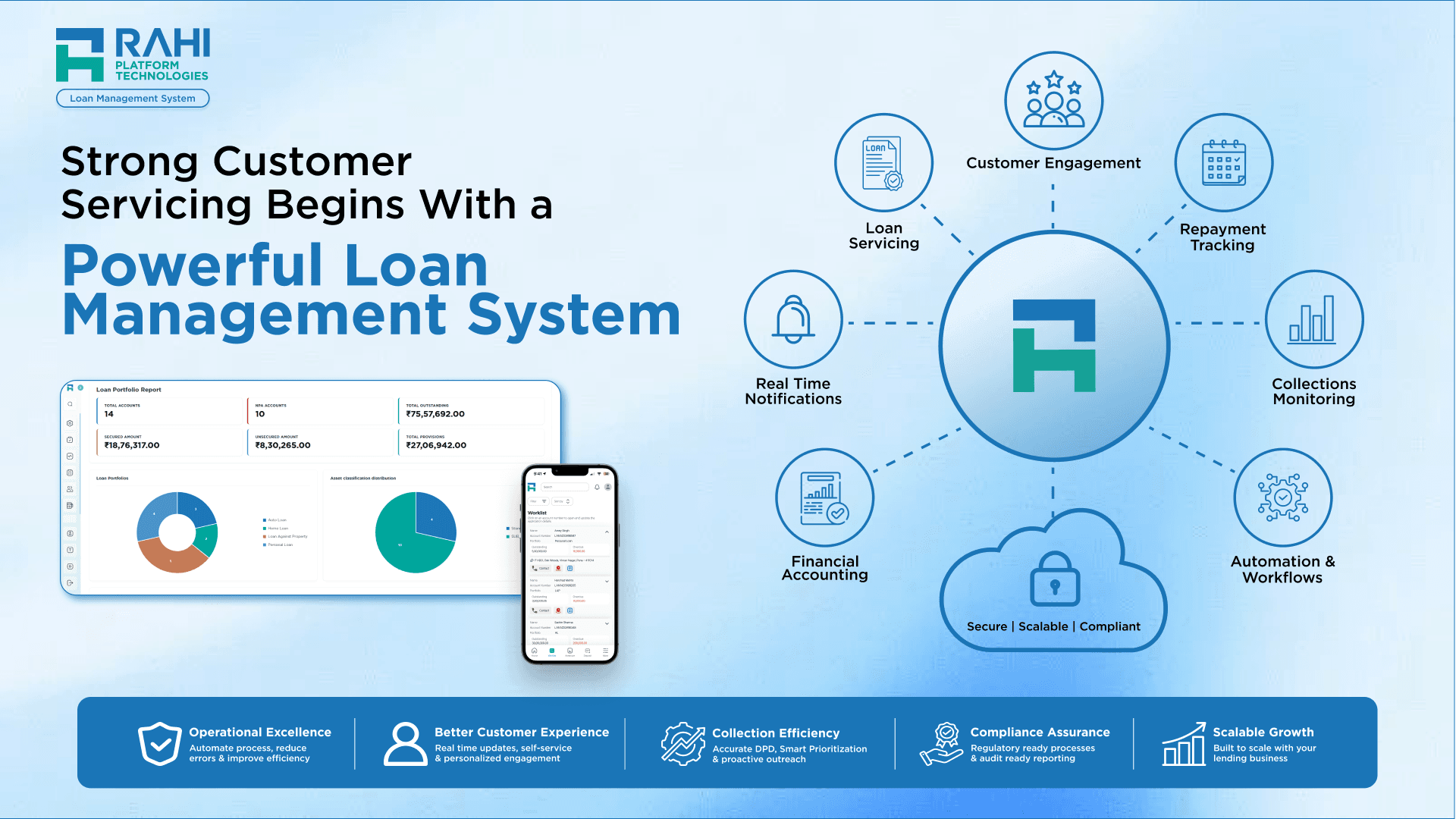
Most conversations in lending revolve around acquisition.
Faster onboarding. Smarter underwriting. Instant approvals. Digital journeys.
But the real operational complexity starts after the loan is disbursed.
Because disbursing a loan is a moment. Managing it is a multi-year operational responsibility.
Every repayment, every schedule adjustment, every restructuring request, every accounting entry, every delinquency movement, and every customer communication becomes part of a continuous servicing lifecycle.
And this is exactly where many lending operations begin to experience friction.
Loan Servicing Is No Longer a Back-Office Function
For years, loan management was treated as a support operation.
Today, it directly impacts:
Customer experience
Portfolio quality
Compliance readiness
Operational efficiency
Collection effectiveness
Financial accuracy
A delay in repayment allocation, incorrect DPD calculation, fragmented accounting entries, or poor borrower communication can create operational stress across the entire lending ecosystem.
Modern lending institutions require far more than static repayment tracking systems.
They need intelligent Loan Management Systems capable of handling operational complexity at scale.
Complexity Is the New Normal in Lending
Loan products are evolving rapidly.
Servicing systems today must support:
Moratorium structures
Balloon repayments
Bullet schedules
Step-up & step-down EMI structures
Partial prepayments
Restructuring and rescheduling
Settlement and write-off tracking
The challenge is not simply managing loans.
The challenge is managing dynamic loan behavior efficiently, accurately, and compliantly.
This is where configurable and event-driven loan lifecycle management becomes critical.
Every Transaction Has an Accounting Impact
One of the biggest operational gaps in lending is the disconnect between servicing and accounting.
A repayment is not just a repayment.
It affects:
Interest accruals
Charges
Provisioning
Asset classification
GL entries
Trial balances
Regulatory reporting
Without integrated accounting automation, operational teams spend enormous effort reconciling systems manually.
A modern Loan Management System brings servicing and financial accounting together — ensuring every transaction reflects accurately across the lending lifecycle.
Collections Need Context, Not Just Follow-Ups
Collections efficiency is no longer measured only by recovery.
It is measured by:
Visibility
Timeliness
Prioritization
Communication
Data accuracy
Real-time DPD tracking, automated classifications, configurable repayment apportionment, and event-based triggers help collections teams operate proactively instead of reactively.
Because effective collections begin with accurate servicing intelligence.
Borrowers Expect Continuous Digital Engagement
Customer expectations do not end after disbursement.
Borrowers expect:
Real-time notifications
Self-service access
Repayment visibility
Digital statements
Faster support
Flexible servicing
A disconnected servicing experience creates operational pressure as well as customer dissatisfaction.
Integrated communication and self-service capabilities are now becoming essential components of modern lending infrastructure.
The Future of Lending Depends on Operational Scalability
As portfolios grow, operational inefficiencies scale faster than loan books.
Manual interventions, fragmented systems, reconciliation delays, and batch dependencies eventually slow down growth.
The institutions that will scale successfully are the ones building:
Automated servicing workflows
Real-time accounting frameworks
Configurable product structures
Event-driven processing
Integrated customer servicing ecosystems
Because sustainable lending growth is not built only on origination.
It is built on how efficiently loans are managed throughout their lifecycle.